

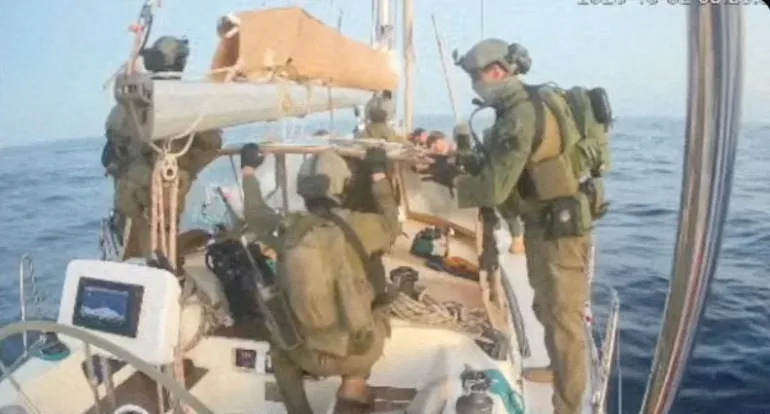
The Israeli navy has intercepted a flotilla carrying humanitarian aid to Gaza, detaining those aboard including Swedish climate activist Greta Thunberg. Israel’s Foreign Ministry said several vessels part of the Global Sumud Flotilla (GSF) were “safely stopped” and that the activists and aid workers were being transferred to an Israeli port.
Authorities claimed they had instructed the flotilla to change its course, warning that it was approaching “an active combat zone.” The flotilla organizers, however, asserted that the interception was “illegal,” “not an act of defence,” and a desperate attempt by Israel to prevent humanitarian assistance from reaching Gaza.
Claims of Force and Disruption
According to the flotilla’s organizers, Israeli forces rammed one vessel intentionally and used water cannons on others. They also accused Israel of deliberately disrupting ship communications to block distress signals or livestreaming of the boarding operations. GSF says the interception happened roughly 70 nautical miles from Gaza’s shoreline.
Live feeds from some vessels suggest that not all 44 ships in the flotilla have been boarded or evacuated. Video posted by Israel shows Greta Thunberg seated on a deck, being handed water and a jacket by an Israeli military member.
Israel has defended its operation, arguing that the flotilla was breaching a lawful naval blockade around Gaza. The government referred to the mission as a provocation, insisting that humanitarian aid must go through recognized land crossings under supervision.
International Response and Fallout
The interception has sparked protests across several countries, including Greece, Italy, Germany, Tunisia, and Turkey. The UN human rights chief, Volker Türk, urged Israel to lift the blockade and allow free passage of life-saving aid without obstruction.
Turkey condemned the maneuver as an “act of terrorism,” demanding accountability for the perpetrators. Colombia, in protest, expelled Israeli diplomats and annulled its free trade agreement with Israel, calling the interception an “international crime by Netanyahu.”
European officials also voiced concern. France’s foreign minister stressed that any boarding should occur with maximum security and respect for human rights. Italy’s foreign minister said he had received assurances from Israel that no violent actions would be taken against the 500 people aboard, including European politicians. Ireland’s deputy prime minister said his government expects Israel to uphold international law.

Broader Context & Humanitarian Crisis
This interception is not Israel’s first attempt to block maritime aid to Gaza—previous flotilla efforts in June and July were similarly thwarted. Israel maintains that such measures are necessary to prevent materials from falling into Hamas’s hands, whereas critics argue the blockade is choking off essential supplies.
UN agencies have warned that Gaza is already facing famine conditions, attributing it in part to Israel’s “systematic obstruction” of aid deliveries. Meanwhile, Israel has dismissed some of the UN’s claims as lies.
On the ground, Israel has intensified its military operations in Gaza City and called on civilians to evacuate southward, alleging that those remaining are supporters of terrorism. The Red Cross has reiterated that under international humanitarian law, civilians—whether they stay or flee—must be protected.










Leave a comment