

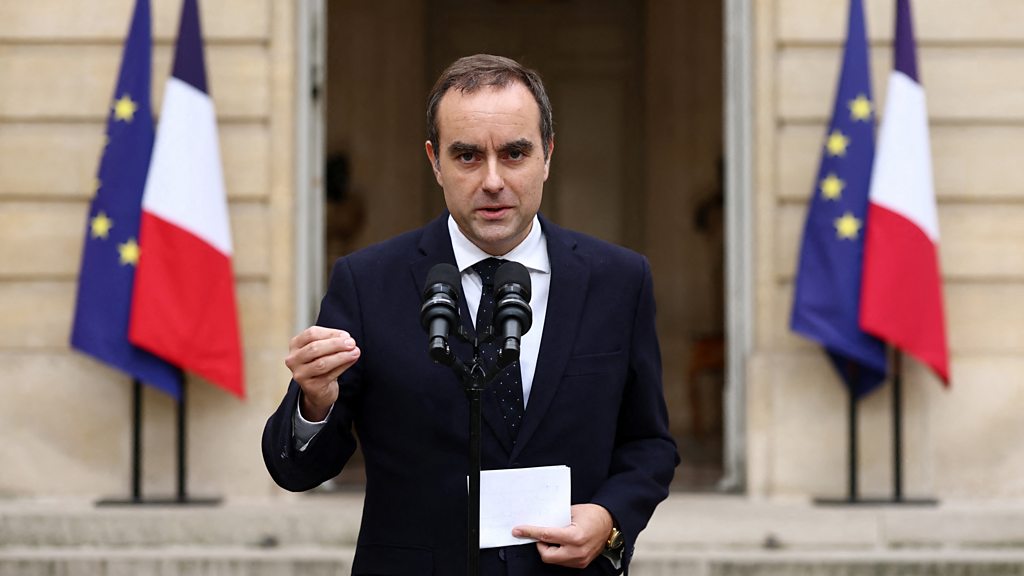
Paris: France was thrown into fresh political turmoil on Monday after Prime Minister Sebastien Lecornu and his newly formed government abruptly resigned—just hours after announcing the new cabinet lineup—making it the shortest-lived government in modern French history.
The shock resignation, which came only 14 hours after Lecornu unveiled his ministers, sent French stocks and the euro tumbling, deepening an already severe political crisis that has gripped President Emmanuel Macron’s administration.
According to the Élysée Palace, Lecornu submitted his resignation on Monday morning, which the president “accepted immediately.” The announcement came less than a day after Lecornu’s cabinet was finalized following weeks of political consultations.
Crisis Erupts Over New Cabinet
Lecornu, a close ally of Macron and France’s fifth prime minister in just two years, had spent weeks attempting to assemble a government that could bridge the political divides in a fragmented National Assembly. But his cabinet announcement on Sunday triggered outrage from across the political spectrum.
Opponents on both the right and left accused Lecornu of favoring one side or the other, while even some of Macron’s centrist allies expressed dissatisfaction. With no party holding a clear majority in parliament, Lecornu’s government faced an immediate risk of collapse.
By Monday morning, facing threats of no-confidence motions and internal dissent, Lecornu tendered his resignation. “Mr. Sebastien Lecornu has submitted the resignation of his Government to the President of the Republic, who has accepted it,” the Élysée said in a brief statement.
Opposition Demands Snap Elections
The resignation renewed calls for a snap parliamentary election. The far-right National Rally (RN), which has been gaining ground in opinion polls, immediately urged Macron to dissolve the National Assembly.
“There can be no return to stability without a return to the polls and the dissolution of the National Assembly,” said RN leader Jordan Bardella.
Meanwhile, Mathilde Panot of the hard-left France Unbowed (LFI) party said the crisis underscored Macron’s failure to maintain political order. “Lecornu resigns—three prime ministers defeated in less than a year. The countdown has begun. Macron must go,” she declared.
Economic Fallout
The political upheaval rattled financial markets. Paris’ CAC 40 index plunged 2%, marking its sharpest single-day decline since August. Major French banks suffered steep losses, with BNP Paribas, Société Générale, and Crédit Agricole dropping between 5.7% and 7.3%.
The euro also weakened, sliding 0.7% to $1.1665, reflecting investor anxiety over France’s deepening political instability—the worst since the founding of the Fifth Republic in 1958.
Roots of Instability
Since Macron’s re-election in 2022, French politics has grown increasingly unstable. His centrist alliance has lost its parliamentary majority, leaving him dependent on shifting coalitions to pass legislation. Last year’s snap election—intended to restore authority—backfired, producing an even more divided parliament where neither bloc commands a majority.
Lecornu’s brief tenure—just 27 days as prime minister and 14 hours in office with a full cabinet—highlights the challenges Macron faces in governing a fractured nation.
Analysts warn that France’s political system, designed to ensure strong presidential authority and stability, is showing signs of strain. Macron, once hailed for reshaping France’s political landscape, now finds himself hemmed in by both the far-right and far-left, with no clear path to consensus.
“France is not used to coalition-building or compromise,” said one senior political analyst in Paris. “The system was never built for this level of fragmentation—and Macron is paying the price.”










Leave a comment