

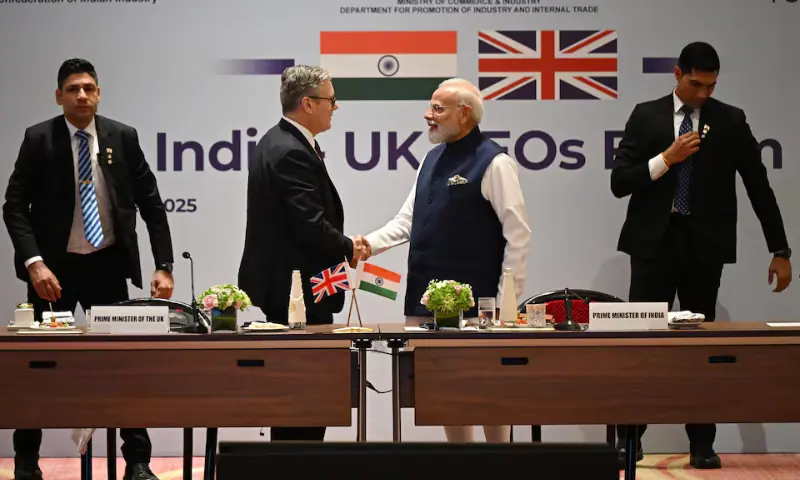
Britain announced on Thursday the signing of a £350 million ($468 million) defence deal with India to supply the Indian Army with UK-manufactured lightweight missiles, marking a major step forward in the deepening strategic and military partnership between the two nations.
The agreement was unveiled as British Prime Minister Sir Keir Starmer met his Indian counterpart, Narendra Modi, in Mumbai. Both leaders hailed the growing momentum in bilateral relations, particularly following the recent conclusion of a trade agreement aimed at boosting investment and economic cooperation.
According to a statement issued by the UK government, the deal covers the supply of Lightweight Multirole Missiles (LMMs) produced by Thales in Northern Ireland. The contract is expected to safeguard around 700 jobs at the Thales facility, which is already manufacturing similar missile systems for Ukraine.
“The deal paves the way for a broader complex weapons partnership between the UK and India, currently under negotiation between the two governments,” the statement noted. The partnership is part of a wider initiative to enhance defence collaboration, technology transfer, and co-production of advanced weapons systems.
The missile contract also reflects Prime Minister Starmer’s broader economic strategy, which places defence exports at the heart of his growth agenda. His government has pledged to raise defence spending in line with NATO commitments and to strengthen the UK’s defence manufacturing base through major international export deals. In recent months, Britain has concluded several high-value defence agreements, including a $13.5 billion frigate deal with Norway.
In addition to the missile pact, Britain announced a new milestone in naval cooperation with India. Both countries signed the next phase of a partnership to develop electric-powered engines for naval vessels — an agreement valued at an initial £250 million. The move underscores the expanding scope of UK-India defence collaboration, extending beyond arms sales to joint innovation and sustainable maritime technology.
Officials from both sides described the agreements as part of a long-term strategic vision to enhance regional security and promote technological self-reliance through joint development initiatives.













Leave a comment