

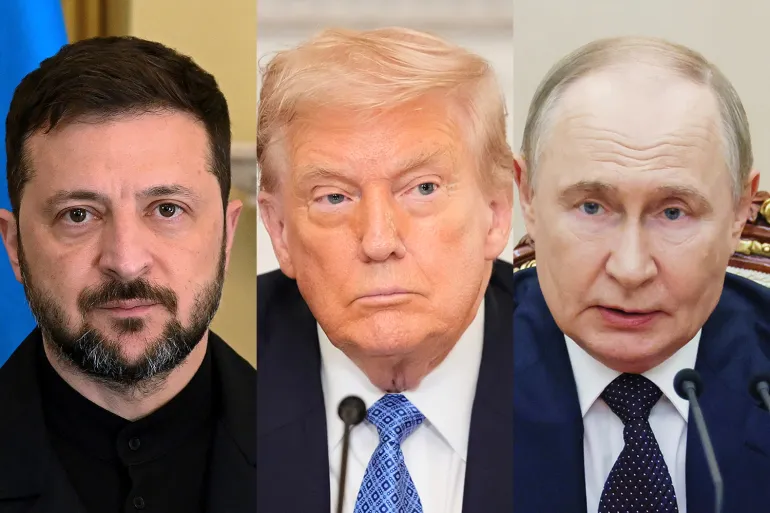
U.S. President Donald Trump has called for an immediate halt to fighting between Russia and Ukraine, urging both countries to accept existing battle lines as the basis for future peace negotiations — a move widely viewed as favouring Moscow’s current territorial gains.
Speaking to reporters aboard Air Force One, Trump said both sides “should stop right now at the battle lines, go home, stop killing people and be done.” He proposed freezing the frontline, which largely encompasses eastern Ukraine’s Donbas region, where much of the territory remains under Russian control.
When pressed on whether this would mean formal recognition of Russia’s occupation, Trump replied, “Let it be cut the way it is right now. It’s cut up right now… They can negotiate something later on down the line.” He added that “about four-fifths” of the Donbas region was already under Russian control.
Ukraine Reacts With Concern
The proposal drew cautious but concerned reactions from Kyiv. President Volodymyr Zelenskyy, who met Trump at the White House earlier this week, reiterated his commitment to ending the war but rejected any arrangement that would legitimise Russia’s territorial occupation. He maintained that any ceasefire must respect Ukraine’s sovereignty and international borders.
Ukrainian officials stressed that halting the war along the current front lines without binding guarantees could leave the country vulnerable to future attacks. They warned that accepting the status quo would amount to rewarding aggression and undermining international law.
A Shift in U.S. Policy
Trump’s comments mark a notable departure from long-standing U.S. policy, which has emphasised full support for Ukraine’s territorial integrity. By suggesting that the current front lines become the foundation for negotiations, Washington risks appearing to validate Moscow’s military advances since the 2022 invasion.
The proposal also signals a potential recalibration in U.S. foreign policy as Trump prepares for a planned meeting with Russian President Vladimir Putin in Budapest later this month. Analysts say Trump’s approach reflects a pragmatic but controversial attempt to end the conflict quickly — possibly at the expense of Ukraine’s sovereignty.
European allies have expressed concern that Trump’s plan could weaken NATO’s unified stance against Russian aggression and erode Western deterrence. Diplomats fear that formalising Russia’s gains could embolden similar actions elsewhere, destabilising Europe’s broader security architecture.
Challenges and Uncertain Prospects
While Trump’s call for an immediate freeze appeals to those eager for peace, experts note significant obstacles to implementing such a plan. Russia has shown no willingness to end hostilities without securing lasting control over occupied regions, while Ukraine insists it cannot accept a deal that cedes its land.
The absence of an international enforcement mechanism, a defined peace framework, or security guarantees further complicates the proposal. Analysts caution that a “frozen conflict” could merely pause fighting temporarily while laying the groundwork for renewed violence later.
For Ukraine, agreeing to a territorial freeze would be seen domestically as a political and moral defeat, while for Russia, it would consolidate its gains without facing major consequences. Trump’s proposal thus exposes deep divisions over how to achieve peace — and whether a ceasefire based on current realities can truly end the bloodshed.






Leave a comment