

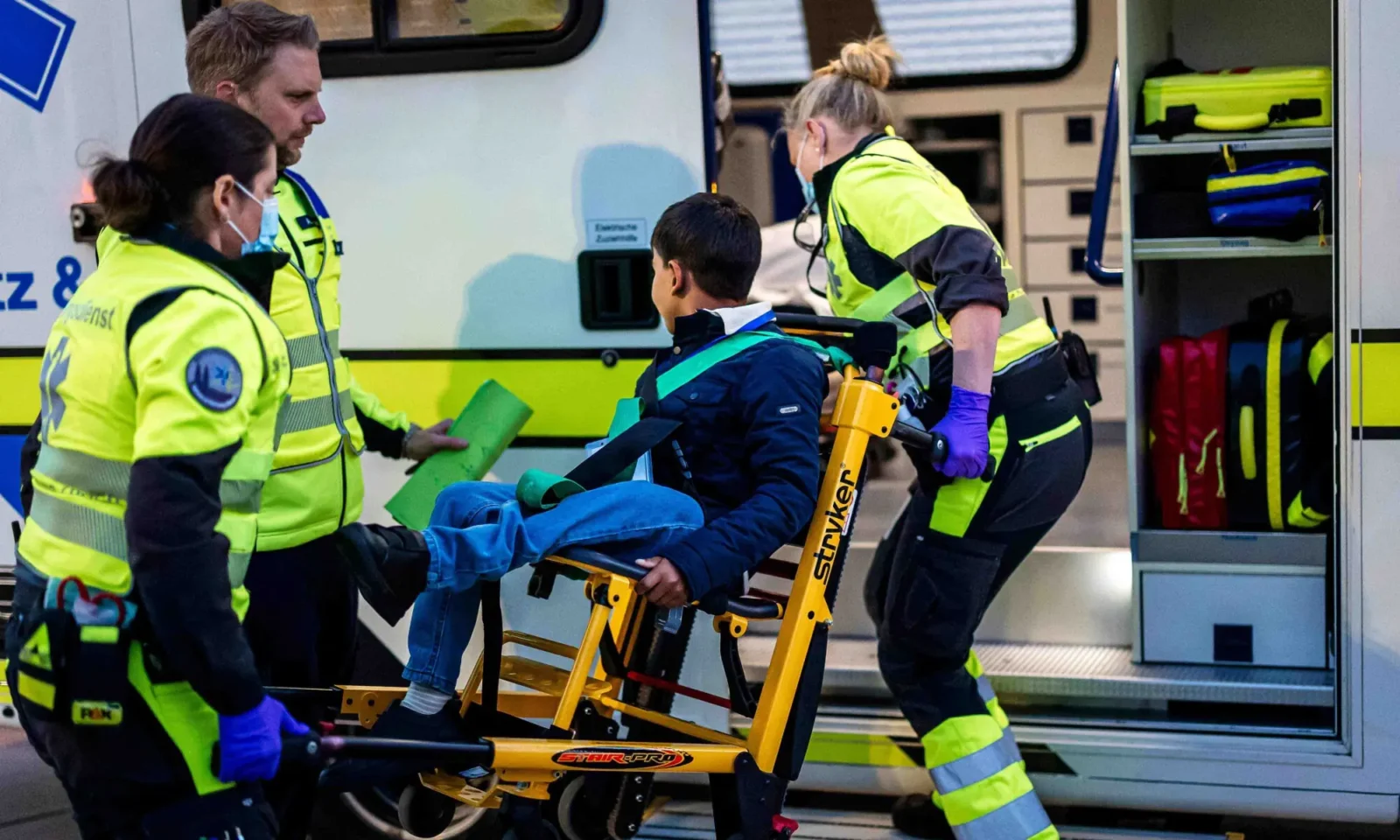
Jerusalem: The United Nations Children’s Fund (UNICEF) has warned that Gaza is on the brink of producing a “lost generation” of children, as nearly all schools remain destroyed or unusable after two years of relentless war. According to Edouard Beigbeder, UNICEF’s Regional Director for the Middle East and North Africa, the ongoing crisis has left children wandering the streets with nothing to do and little hope for the future.
“This is the third year that there has been no school,” Beigbeder said in an interview with AFP after returning from Gaza. “If we don’t start a real transition for all children in February, we will enter a fourth year — and then we can talk about a lost generation.”
Widespread Destruction and Humanitarian Collapse
Beigbeder described the devastation across Gaza as “almost omnipresent wherever you go.” The prolonged war between Israel and Hamas has turned vast areas into rubble, displaced nearly the entire population at least once, and crippled critical infrastructure.
“It is impossible to imagine 80 percent of a territory that is completely flattened out or destroyed,” he added. Despite a US-brokered ceasefire that came into effect earlier in October, the destruction has left 85 percent of Gaza’s schools either destroyed or unfit for use.
Many remaining school buildings are being used as temporary shelters for displaced families. Teachers and students alike are on the move, struggling to survive amid dire humanitarian conditions.
Temporary Learning Centers Offer Little Relief
UNICEF and its education partners have managed to reopen temporary learning centers for roughly one-sixth of Gaza’s children. These facilities, Beigbeder said, offer basic lessons in reading, mathematics, and writing for three days a week.
However, he stressed that these centers are “far from a formal education.” Often constructed from metal sheets, plastic coverings, or tents, the makeshift classrooms lack even the most basic resources.
“There are sometimes chairs, cardboard boxes or wooden planks serving as tables, and children write on salvaged slates or plastic boards,” Beigbeder explained. “I’ve never seen everyone sitting properly — most of the children sit on mats or carpets.”
Education Infrastructure ‘Inaccessible’
Before the war, Gaza’s education system was already under strain, with half the population under 18 and schools operating in multiple shifts to accommodate all students. Now, the situation has worsened dramatically.
Of the 300 schools managed by the Palestinian Authority, 142 have been completely destroyed, and 80 require urgent renovation. Another 38 are “completely inaccessible” because they are located in areas recently vacated by Israeli forces under the ceasefire terms.
The UN Relief and Works Agency (UNRWA) announced in October that it had launched a “new e-learning school year” to reach nearly 290,000 Palestinian students remotely. But political complications remain: US Secretary of State Marco Rubio accused UNRWA of being a “subsidiary of Hamas,” vowing that it would play no role in Gaza’s reconstruction.
Barriers to Rebuilding and Aid Delivery
Beigbeder emphasized that rebuilding Gaza’s education system must become an international priority. “We need to put education at the top of the agenda,” he said, noting that almost all children in Gaza are deeply traumatized and in urgent need of psychological support alongside schooling.
UNICEF has called for the immediate approval of border access to bring in construction materials such as cement and essential school supplies — items currently restricted by Israeli authorities as “non-essential.”
“How can you rehabilitate classrooms if you don’t have cement?” Beigbeder asked. “And above all, we need notebooks, books, blackboards — the bare minimum.”
A Crisis of Survival and Hope
The World Health Organization (WHO) reported that since the ceasefire began, there has been little improvement in the flow of aid into Gaza and no reduction in hunger. Israel’s restrictions on food, fuel, and building materials have worsened the humanitarian crisis, pushing many parts of Gaza to the brink of famine.
Beigbeder summed up the gravity of the situation in stark terms:
“Food is survival. Education is hope.”
Unless education is rapidly restored, UNICEF warns that an entire generation of Gaza’s children risks growing up without schools, stability, or a sense of future — a tragedy with consequences that could last decades.












Leave a comment