

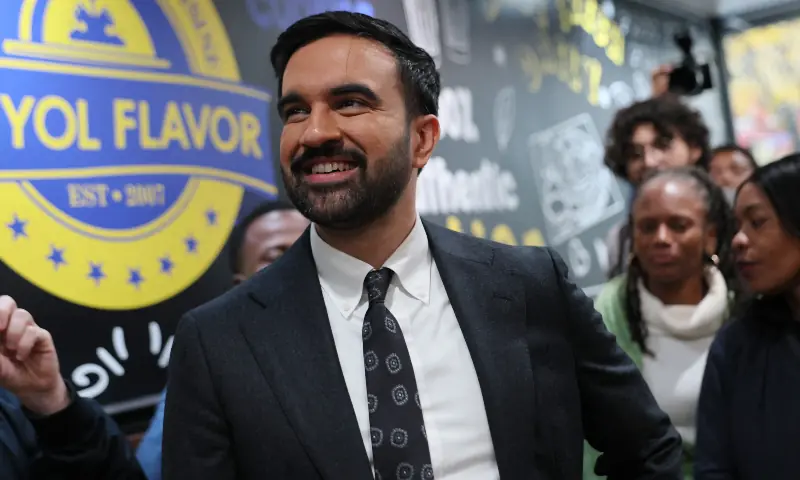
NEW YORK: Early voting for the city’s high-stakes mayoral election began on Saturday, with Zohran Mamdani — a 34-year-old state lawmaker of South Asian descent and self-proclaimed democratic socialist — emerging as the unexpected frontrunner in a race that could redefine New York’s political future.
Once dismissed as a political outsider, Mamdani’s campaign has rapidly gained momentum, fuelled by an energetic base of young, progressive volunteers and widespread frustration over the city’s escalating cost of living. His central campaign promise — to freeze rents for over two million New Yorkers in rent-stabilised homes — has struck a chord with residents struggling to afford housing in one of the world’s most expensive cities.
If elected, Mamdani would make history as New York’s first Muslim mayor — a landmark moment for the city’s diverse population. However, analysts point out that his appeal extends well beyond his religious identity. Mamdani’s popularity is rooted in his progressive policy agenda, which includes strengthening labour unions, implementing wealth taxes, expanding public transit, promoting climate-friendly housing, and ensuring equitable access to healthcare and education.
His emphasis on social inclusion, immigrant protection, and LGBTQ rights has resonated particularly strongly among younger, multiethnic voters — including African American, Latino, and immigrant communities — who see in him a reflection of New York’s evolving identity.
“Mamdani has energised people who feel left out of traditional politics,” said Moviz Siddiqui, a resident of Queens. “He talks about fairness and affordability in a way that connects with everyone — Muslims, Jews, Hindus, atheists — it doesn’t matter.”
Despite his broad support, Mamdani’s campaign has faced a wave of Islamophobic attacks from political opponents attempting to use his faith against him. Addressing supporters outside a Brooklyn mosque on Friday, Mamdani responded with defiance and dignity. “The dream of every Muslim is simply to be treated the same as any other New Yorker,” he said. “For too long, we’ve been told to ask for less — no more.”
The candidate has also drawn attention for his outspoken criticism of Israel’s military actions in Gaza, which he has described as “genocide.” His stance has made him a target of online abuse and conservative backlash. Nonetheless, his popularity remains undented. A Victory Insights poll conducted from October 22 to 23 places Mamdani 18 points ahead of his closest rival, former Governor Andrew Cuomo, with 47 percent support. Republican candidate Curtis Sliwa trails with 16 percent.
After initial hesitation, top Democratic figures have now rallied behind Mamdani. Senate Majority Leader Chuck Schumer and House Minority Leader Hakeem Jeffries both endorsed him, highlighting his growing influence within the party. “Zohran Mamdani has relentlessly focused on addressing the affordability crisis and committed to being a mayor for all New Yorkers,” Jeffries said. Schumer praised Mamdani’s campaign as one that “connected with New Yorkers about fairness, opportunity, and justice,” dismissing right-wing attacks seeking to question his loyalty or citizenship.
Born in Kampala, Uganda, Mamdani comes from a family of intellectual and artistic distinction — his father, Mahmood Mamdani, is a renowned Ugandan Muslim scholar, while his mother, Mira Nair, is a celebrated Indian filmmaker. Having moved to New York as a child, Mamdani embodies a multicultural identity that resonates deeply within the city’s South Asian and immigrant communities.
His candidacy has unified South Asian voters across faith and national lines — including Indian, Pakistani, Bangladeshi, and Nepali communities — though some divisions remain among Muslim leaders. Councilwoman Shahana Hanif praised Mamdani as “a bridge-builder” working to heal the city’s post-9/11 wounds, while New Jersey-based activist Nasir Qayyum Khan cautioned that some of Mamdani’s progressive policies might clash with traditional Muslim values.
Early voting, which has grown in popularity since its 2019 introduction, will continue through November 2, with Election Day scheduled for November 4. In June’s primary, about 35 percent of ballots were cast early — a trend expected to rise this year as voter enthusiasm grows. The winner of the November election will take office in January, setting the tone for New York City’s political and social direction in the years ahead.







Leave a comment