

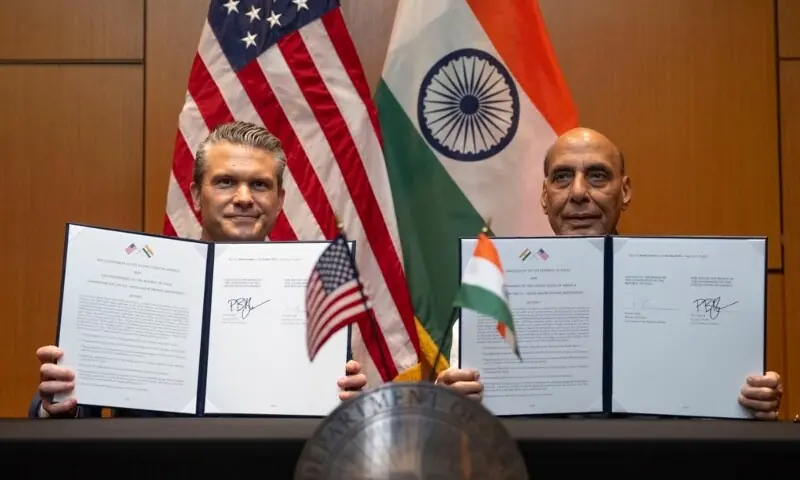
The United States and India have formalised a decade-long defence framework agreement, delivering it publicly on Friday through remarks from U.S. Defence Secretary Pete Hegseth. Hegseth said the framework “advances our defence partnership, a cornerstone for regional stability and deterrence,” marking the strongest military ties the two countries have ever shared.
The pact was signed on the sidelines of the ASEAN Defence Ministers’ Meeting-Plus (ADMM-Plus) in Kuala Lumpur, where India’s Defence Minister Rajnath Singh met Hegseth to exchange the agreement. Singh described the step as ushering in a “new era of defence cooperation between New Delhi and Washington.”
Under the 10-year framework, both governments aim to deepen coordination in intelligence sharing, defence technology, and joint planning for military operations. Hegseth noted that this pact will serve as a roadmap for deeper and more meaningful collaboration in the years ahead.
The timing of the agreement is significant. It comes amid heightened strategic competition in the Indo-Pacific and efforts by both Washington and New Delhi to anchor their partnership more firmly in defence and security. It also follows a series of high-level visits and policy consultations between top U.S. and Indian officials.
For India, the agreement aligns with its broader goal to boost indigenous defence production and reduce reliance on foreign imports under the “Make in India” initiative. The deal is expected to open avenues for joint manufacturing, co-development of advanced systems, and technology transfer between U.S. and Indian firms.
Although full details of the pact have not yet been released, the commitment to a 10-year framework signals a new strategic depth in bilateral relations. Hegseth emphasised that “our defence ties have never been stronger,” reflecting Washington’s view of India as a critical partner in maintaining regional balance and countering shared threats.
For regional players, the agreement underscores an intensified U.S. presence in Asia and India’s growing role as a strategic counterweight. Analysts suggest the pact may soon translate into expanded joint exercises, technology-sharing initiatives, logistics cooperation, and arms supply arrangements, deepening military interoperability between the two sides.
In essence, the U.S.–India 10-year defence framework marks a turning point in their bilateral relationship. It lays the groundwork for sustained cooperation in military, technological, and industrial domains. Whether this momentum leads to lasting strategic outcomes will depend on both nations’ ability to implement the pact effectively and manage emerging geopolitical challenges in the Indo-Pacific region.









Leave a comment