

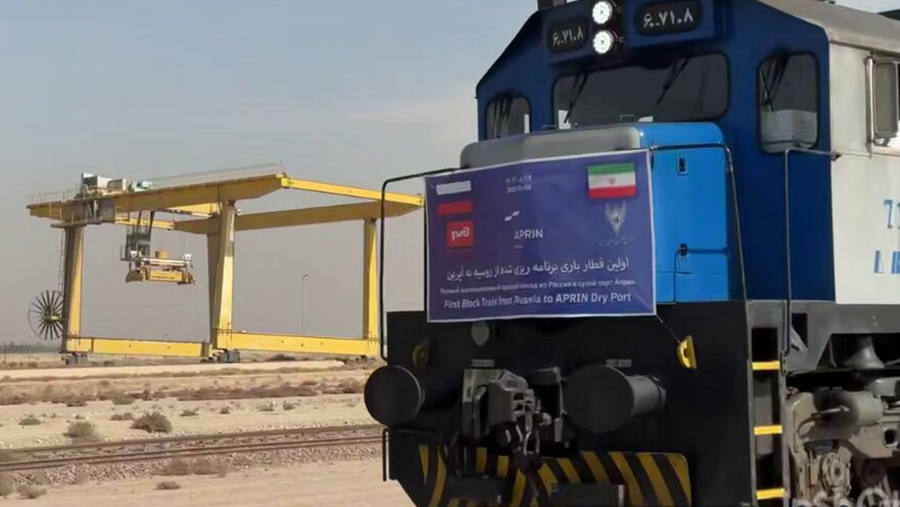
TEHRAN: The first scheduled freight train from Russia arrived at Iran’s Aprin dry port on Saturday, marking a significant milestone in Tehran-Moscow trade relations. The arrival paves the way for regular rail services linking Iran, Russia, and other Central Asian countries, boosting regional commerce and transit efficiency.
The train carried 62 forty-foot containers loaded with paper products, pulp, and related goods destined for Iran and Iraq. Its journey began roughly 900 kilometers north of Moscow, traversing Kazakhstan and Turkmenistan before entering Iran via the Incheh Borun border. The trip took 12 days, reflecting improved coordination along the route.
This operation required close cooperation among railways, customs officials, freight forwarders, and cargo owners. It is being hailed as a major achievement for the International North–South Transit Corridor (INSTC), a key project aimed at enhancing trade links between the Caspian region and the Persian Gulf.
Morteza Jafari, deputy head of commerce and operations at the Islamic Republic of Iran Railways, highlighted that 30 freight trains have arrived at Aprin since June, when the first service from China reached the port. He emphasized Iran’s ambition to expand such operations and establish itself as a regional hub for exports, imports, and transit within the CIS region.
Oleg Poleev, CEO of Russian Railways Logistics, noted that logistics development depends on both economic and political factors. He pointed out that the Moscow–Bandar Abbas route, which previously took significantly longer and cost more, now requires just 15 days thanks to cooperation among Iran, Turkmenistan, and Kazakhstan.
Aprin is described as a strategically located terminal at the intersection of major trade corridors, with strong potential for future growth. On November 3, Iran and Russia agreed to create a joint transport task force and launch a digital single window system to streamline logistics between Tehran and Moscow, addressing procedural challenges and enhancing bilateral trade.
Mehdi Asadi, head of logistics and multimodal transport at Iran’s Ports and Maritime Organization, explained that these initiatives aim to simplify customs procedures, improve transparency, and facilitate smoother trade operations. The agreement follows talks addressing shipping challenges in the Caspian Sea, obstacles along the eastern branch of the INSTC, and trade imbalances between the two countries.
Asadi added that the permanent joint working group would allow regular meetings to monitor progress, coordinate solutions, and expand transport capacity between Iran and Russia. Both sides have expressed a strong commitment to overcoming existing barriers and enhancing regional trade connectivity.











Leave a comment