

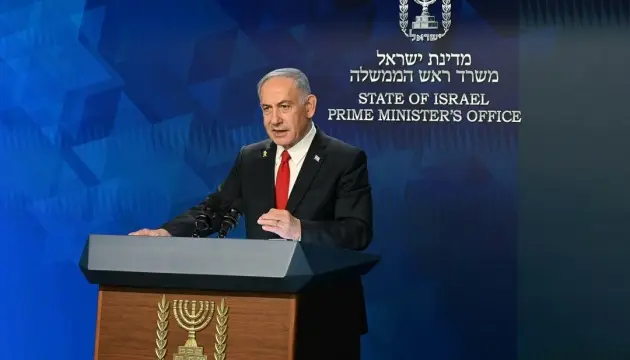
Israeli Prime Minister Benjamin Netanyahu on Sunday reaffirmed his country’s opposition to a Palestinian state, following protests from far-right coalition allies over a US-backed statement supporting a pathway to Palestinian independence.
The controversy comes two days after the United States, along with several Muslim-majority nations, endorsed a draft UN Security Council resolution incorporating President Donald Trump’s Gaza peace plan. The proposal envisions a transitional “Board of Peace” administration in Gaza tasked with post-war reconstruction, economic recovery, and laying the groundwork for eventual Palestinian statehood.
Tensions in the Security Council and on the ground
The 15-member UN Security Council began negotiations on the draft resolution on November 7. Trump’s 20-point plan explicitly suggests that reforms within the Palestinian Authority could create conditions for “a credible pathway to Palestinian self-determination and statehood,” a point that drew strong criticism from Israeli far-right ministers.
Meanwhile, Israeli military operations continued in Gaza and the West Bank. On Sunday, Israeli forces killed four Palestinians—three in southern Gaza and one in Nablus in the West Bank—highlighting the ongoing violence amid diplomatic negotiations.
Far-right backlash tests Netanyahu’s coalition
The mention of a potential Palestinian state infuriated Netanyahu’s far-right coalition partners, who had previously opposed the October ceasefire in Gaza brokered by Trump. Far-right ministers Itamar Ben-Gvir and Bezalel Smotrich publicly pressured Netanyahu to reject the concept of Palestinian statehood, with Ben-Gvir threatening to leave the government if he did not act.
In response, Netanyahu issued a statement on Sunday emphasizing that Israel’s position remains unchanged: “Our opposition to a Palestinian state in any territory has not changed. Gaza will be demilitarised and Hamas will be disarmed, the easy way or the hard way. I do not need affirmations, tweets or lectures from anyone.” Analysts say a walkout by far-right ministers could destabilize Netanyahu’s coalition and potentially bring down his government ahead of elections scheduled by October 2026.
Broader political and diplomatic context
Israeli Defence Minister Israel Katz and Foreign Minister Gideon Saar also released statements opposing a Palestinian state, although they did not directly reference Netanyahu. The Trump-backed Gaza plan, which Netanyahu supported during a September visit to the White House, successfully ended major hostilities between Israel and Hamas, following two years of war that devastated Gaza and triggered regional instability.
Despite Netanyahu’s earlier promises to respond to countries like France, which formally recognised a Palestinian state in September, critics say he had remained largely silent on the issue until Sunday. Smotrich, in particular, accused the prime minister of political inaction and urged him to clarify Israel’s stance to the international community, declaring, “A Palestinian state will never arise on the lands of our homeland.”
Human toll of the conflict
The Gaza conflict has left a heavy human cost. Local health authorities report that over two years of Israeli bombardments and ground offensives killed more than 69,000 Palestinians, underscoring the continuing humanitarian crisis even as diplomatic efforts and ceasefire agreements attempt to stabilize the region.









Leave a comment