

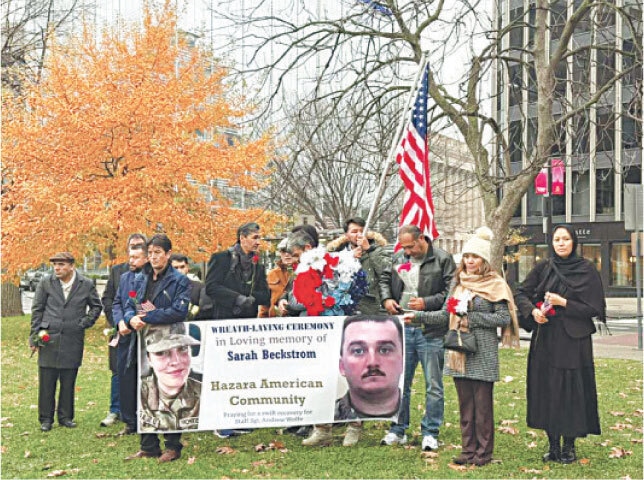
WASHINGTON: Afghan Americans from multiple neighborhoods gathered outside the White House on Sunday, urging the US government to refrain from assigning collective blame to their entire community over the actions of a few individuals. The demonstration came at a time of heightened scrutiny of Afghan nationals in the United States, following recent reports linking some individuals to terrorism-related incidents.
The rally, organised by the Hazara American Community, sought to remind policymakers that Afghan immigrants — particularly the historically persecuted Hazara minority — should not be viewed through the lens of isolated criminal cases. Community leaders emphasised that sweeping generalisations fuel prejudice and deepen fear among already vulnerable groups.
The protest took place the same day the US Justice Department announced that Afghan-born permanent resident Abdullah Hajizada had been sentenced to 15 years in federal prison. Hajizada, who was 17 at the time of his arrest, had pleaded guilty to conspiring to supply firearms and ammunition for an ISIS-inspired plot to attack on election day in November 2024. Prosecutors said he had procured two AK-47-style rifles and 500 rounds of ammunition “knowing they would be used to commit a violent federal crime.” He will be deported to Afghanistan and stripped of his permanent residency upon completing his sentence.
Concerns within the Afghan diaspora deepened further after authorities indicated that they may also deport the family of Rahmanullah Lakanwal, who fatally shot a National Guard soldier and injured another in Washington last week. On the same day, another Afghan national, Mohammad Dawood Alokozay, was arrested in Texas for allegedly making terror-related threats — events that collectively intensified public scrutiny.
In a statement, the Hazara American Community stressed that “criminal responsibility lies with the individual” and warned against policies or rhetoric that stigmatise entire ethnic or immigrant groups. The organisation highlighted the irony that Hazaras, who have faced systematic discrimination and violence in Afghanistan for decades, now fear being collectively judged in the US as well.
Immigrant-rights groups and Afghan-American advocacy organisations also voiced alarm over what they see as a dangerous rise in xenophobic sentiment. Matthew Soerens, vice president of World Relief, urged Americans to resist generalisations based on nationality, religion, or immigration status. “These actions are those of one person,” he said, “not a reflection of entire communities.”
Shawn VanDiver, president of AfghanEvac, said fear has gripped many Afghan refugee families. “People are acting xenophobic because of one deranged man,” he said. “He doesn’t represent all Afghans. He represents himself.”
UN Special Rapporteur on human rights in Afghanistan, Richard Bennett, added that while accountability for perpetrators is essential, punishing an entire community is unacceptable.
Arash Azizzada, co-director of Afghans For A Better Tomorrow, cautioned political leaders against exploiting the recent incidents to justify harsher policies. He also noted that Lakanwal had previously worked alongside US Special Operations forces in CIA-backed Afghan paramilitary units — groups that operated with little oversight and were linked to human rights abuses during the war.
Evacuate Our Allies, a coalition supporting Afghan evacuees, condemned last week’s attack but denounced what it described as the “alarming vilification” of Afghan immigrants more broadly. The group said collective blame “undermines the immense sacrifices our nation’s Afghan allies made — sacrifices that cost many their safety, homes, loved ones, and, in too many cases, their lives.”






Leave a comment