

A strong earthquake struck off northern Japan on Friday, the Japan Meteorological Agency (JMA) reported, coming just days after a more powerful tremor jolted the same region and left at least 50 people injured. The JMA later upgraded Friday’s quake to a magnitude 6.7 and issued a tsunami advisory, cautioning that waves up to one metre could reach parts of the northern Pacific coastline.
According to the agency, tsunami waves ultimately reached heights of around 20 centimetres in Hokkaido and Aomori, prompting authorities to lift the advisory shortly afterward. Public broadcaster NHK said no noticeable changes were observed at ports where the waves arrived.
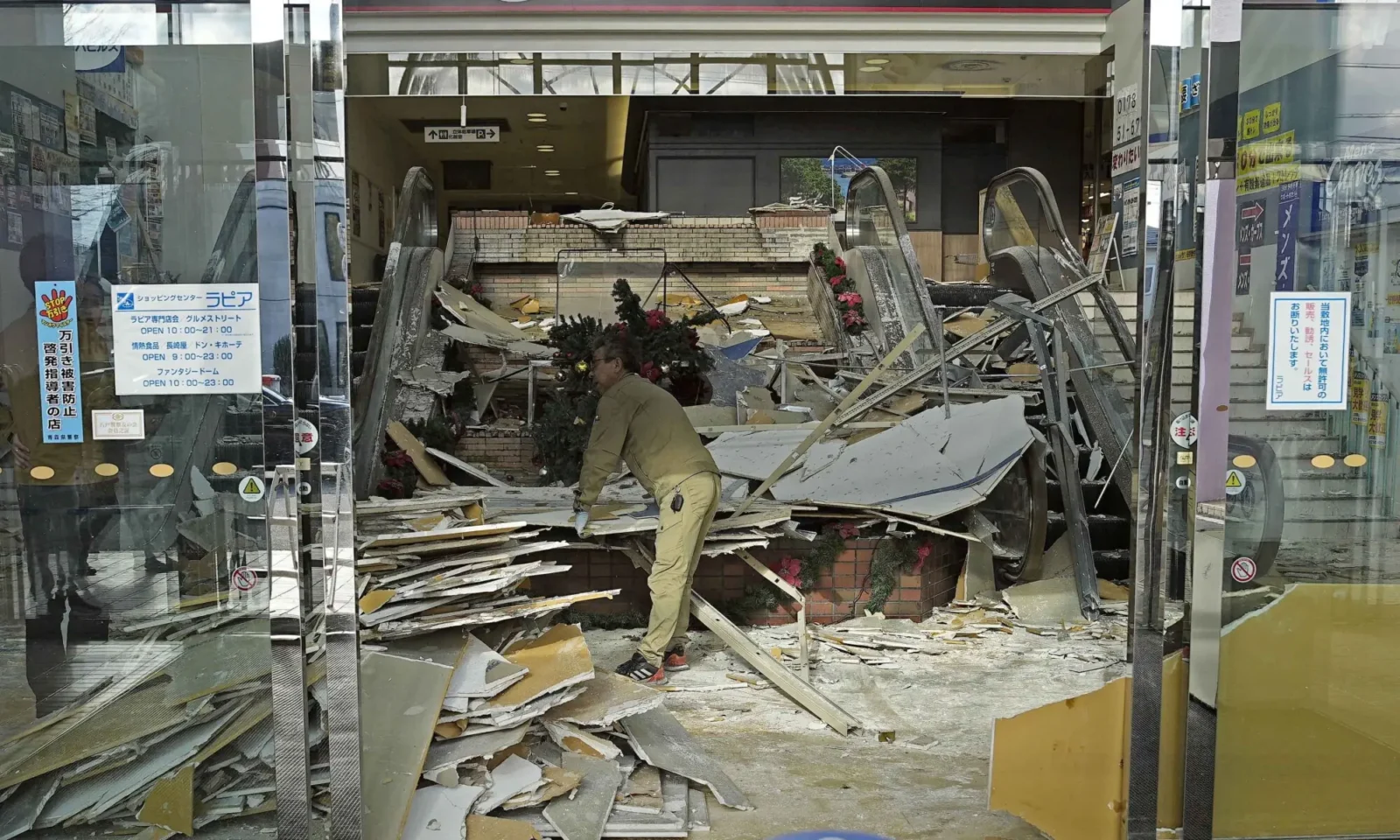
The United States Geological Survey confirmed the magnitude at 6.7, placing the quake’s epicentre roughly 130 kilometres off the city of Kuji in Iwate prefecture. NHK noted that Friday’s shaking was less intense than Monday night’s 7.5-magnitude quake, which caused widespread disruption — toppling items from shelves, damaging roads, breaking windows, and generating tsunami waves of up to 70 centimetres.
In the aftermath of Monday’s quake, local authorities issued an evacuation order on Thursday for residents living near a 70-metre steel tower in Aomori after structural damage raised fears it could collapse. Meanwhile, Japan’s Nuclear Regulation Authority said on Friday that no irregularities had been detected at any nuclear facilities in the affected areas.
Following Monday’s powerful tremor, the JMA took the unusual step of issuing a special advisory warning of the possibility of another earthquake of equal or greater strength within a week. The alert covered the Sanriku coast on northeastern Honshu and the island of Hokkaido, both facing the Pacific.
The region remains deeply conscious of the catastrophic 9.0-magnitude undersea quake in 2011, which unleashed a massive tsunami that claimed around 18,500 lives. In August 2024, the JMA issued a similar advisory for Japan’s southern Pacific coast, warning of a potential “megaquake” along the Nankai Trough — an 800-kilometre undersea trench where the Philippine Sea plate is sliding beneath the Japanese archipelago.
Government assessments suggest that a major quake along the Nankai Trough and the ensuing tsunami could kill nearly 298,000 people and result in up to $2 trillion in economic losses. Although last year’s advisory was lifted after one week, it triggered panic-buying and led to mass cancellations of holiday bookings.
Japan, located at the convergence of four tectonic plates on the Pacific “Ring of Fire,” remains one of the world’s most earthquake-prone nations. The country registers roughly 1,500 quakes each year, the vast majority of them minor, yet the extent of damage depends heavily on where they strike and how deep they originate.













Leave a comment