

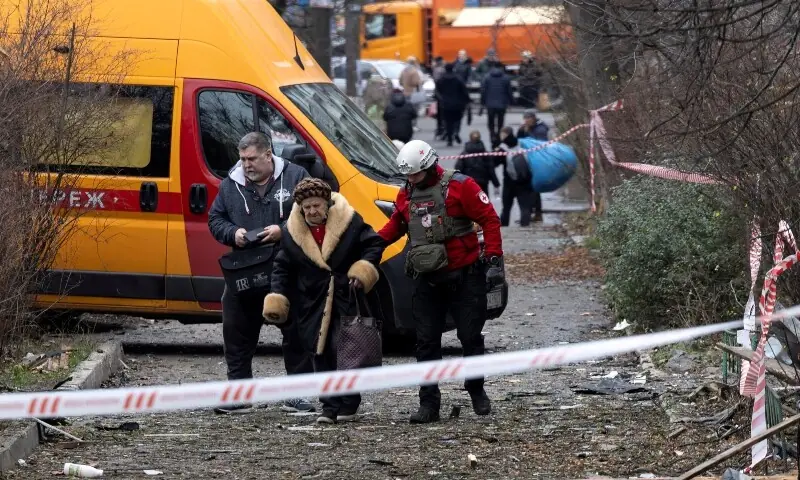
Russian missile and drone attacks on Ukraine on Tuesday killed at least three people, including a four-year-old child, and caused widespread power outages in the country’s western regions. The strikes prompted Poland, a NATO member bordering western Ukraine, to scramble jets to defend its airspace, highlighting the escalating tensions in the region amid ongoing US-led peace talks.
The attacks targeted energy infrastructure across at least 13 regions, according to Ukrainian President Volodymyr Zelenskiy, just days after another round of international discussions aimed at ending the nearly four-year-old conflict. Zelenskiy condemned the strikes, saying on X that Russian President Vladimir Putin “still cannot accept that he must stop killing” and called on the international community to increase pressure on Moscow.
The casualties included a child in the central Zhytomyr region, one person in Khmelnytskyi in western Ukraine, and a third individual outside Kyiv. At least five others were wounded in the capital. Ukrainian authorities said the strikes severely impacted power grids and disrupted energy supplies, leaving many areas in darkness.
Russia’s defence ministry stated that the attacks targeted Ukrainian energy and military facilities and claimed the capture of two villages along the front line. Kyiv did not immediately confirm these territorial claims, which it often disputes. The intensification of strikes on Ukrainian energy and logistics is widely seen as Moscow’s attempt to pressure Kyiv to alter the terms of a US-backed peace agreement, while Ukraine has simultaneously targeted Russian energy exports.
In a related development, Ukrainian drone attacks overnight reportedly caused fires at industrial and fuel oil facilities in Russia’s southern Stavropol region and the port of Taman in Krasnodar, though the fires were extinguished, regional officials said.
Concerns have also grown over the safety of the defunct Chernobyl nuclear power station. Plant director Sergiy Tarakanov warned that repeated Russian strikes could cause the collapse of the internal radiation shelter, which had already been damaged by previous attacks. Tarakanov said full restoration could take three to four years, and even a nearby missile or drone strike could trigger a “mini-earthquake” and severe radiological consequences. The International Atomic Energy Agency (IAEA) had previously warned that the outer radiation shell had lost its primary safety functions after earlier Russian hits.
The attacks underscore the continued volatility in Ukraine, with Russian forces intensifying military operations while targeting critical infrastructure, and raise urgent concerns about civilian safety, regional energy security, and the potential for nuclear hazards.












Leave a comment