

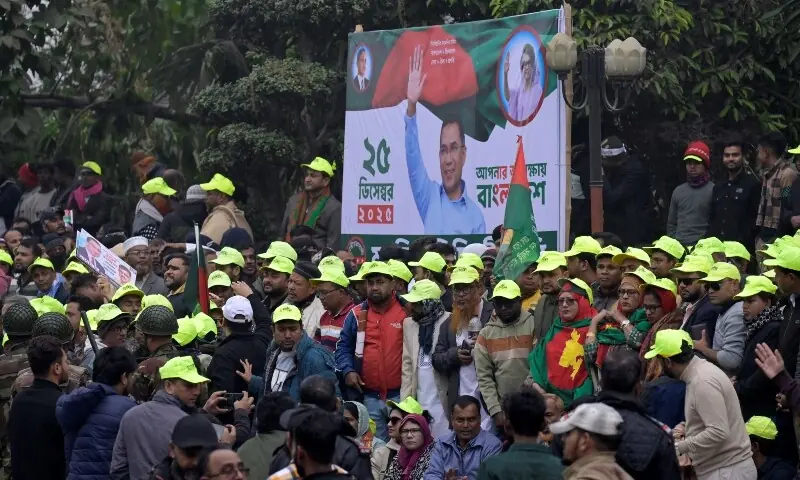
DHAKA: Bangladesh Nationalist Party (BNP) acting chairman Tarique Rahman returned to Dhaka on Thursday after nearly 17 years in exile, a high-profile homecoming that the party hopes will galvanise its support ahead of the February 12 general elections. Rahman is widely seen as the BNP’s top contender for prime minister at a time of major political transition in the country.
Hundreds of thousands of BNP supporters lined the roads from Dhaka’s international airport to the reception venue, waving party flags and holding banners, placards and flowers as they chanted slogans welcoming their leader. Senior BNP figures received Rahman at the airport amid tight security arrangements, reflecting both the scale of the gathering and lingering political sensitivities.
Rahman, 60, the son of former prime minister Khaleda Zia, has lived in London since 2008 and has served as BNP acting chairman since 2018. Dressed in a light grey checkered blazer over a white shirt, he waved to supporters with a calm smile as he made his way through the crowds.
His prolonged absence from Bangladesh had been due to multiple criminal cases filed against him, including convictions in absentia on charges such as money laundering and in a case linked to an alleged plot to assassinate former prime minister Sheikh Hasina. Those verdicts were overturned after Hasina was ousted last year in a student-led uprising, removing the legal obstacles to Rahman’s return.
Rahman’s homecoming also carries strong personal significance. Khaleda Zia has been seriously ill for months, and party officials said Rahman would visit his mother after attending a reception following his arrival in the capital.
Bangladesh’s political landscape has shifted dramatically since Hasina’s removal from power, ending decades of rivalry in which she and Khaleda Zia alternated as the country’s dominant political figures. The BNP is now seeking to capitalise on the changed environment and position itself as the leading force in the upcoming elections.
A December survey by the US-based International Republican Institute suggested the BNP is on track to secure the largest number of parliamentary seats, with the Islamist Jamaat-e-Islami also contesting the polls. Meanwhile, Hasina’s Awami League, which has been barred from participating, has threatened unrest — raising fears of potential disruption.
The elections will be held under an interim government led by Nobel laureate Muhammad Yunus. Although authorities have pledged to ensure a free and peaceful vote, recent attacks on media outlets and sporadic violence have heightened concerns. In this context, Rahman’s return is being seen as a pivotal moment for both the BNP and Bangladesh’s fragile democratic transition.












Leave a comment