

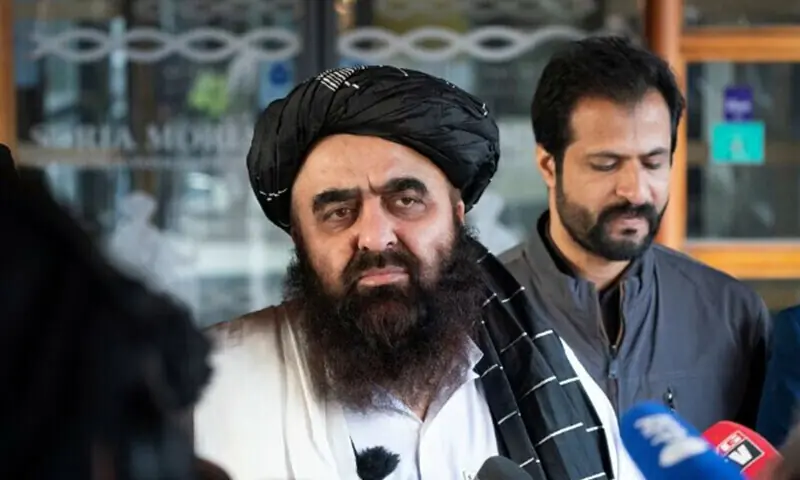
KABUL: Afghanistan’s Taliban-appointed Foreign Minister Amir Khan Muttaqi departed for New Delhi on Wednesday for what marks the first official visit to India by a Taliban leader since the group returned to power in August 2021. The Afghan foreign ministry confirmed that Muttaqi would engage in high-level talks aimed at improving political, economic, and trade relations between the two countries.
During his visit, Muttaqi is scheduled to meet Indian Foreign Minister Subrahmanyam Jaishankar and other senior Indian officials in New Delhi. The agenda includes discussions on a wide range of bilateral issues such as trade, humanitarian aid, regional security, and potential cooperation in health and education. The Taliban foreign ministry stated that the talks would also cover consular matters, exports of Afghan dry fruits, and the facilitation of Afghan goods through Indian ports.
The visit comes a day after Muttaqi participated in a regional conference in Moscow, attended by officials from Afghanistan’s neighbouring states including Pakistan, Iran, China, and Central Asian countries. The joint declaration issued at the meeting opposed the establishment of any foreign military infrastructure in the region, widely interpreted as a message to Washington following US President Donald Trump’s stated intention to reclaim the Bagram Air Base near Kabul.
Russia remains the only country to have formally recognised the Taliban government. Other regional powers, including India, have so far refrained from extending formal diplomatic recognition, though they maintain limited engagement. Historically, India and Afghanistan shared strong diplomatic and developmental ties prior to the Taliban’s takeover. However, New Delhi shut down its embassy in Kabul following the chaotic US withdrawal in 2021, citing security concerns.
A year later, India reopened a limited diplomatic mission in Kabul to facilitate humanitarian aid, trade coordination, and consular support. Since then, both sides have engaged in discreet dialogue, with a series of meetings between their respective foreign ministry officials aimed at easing tensions and exploring pragmatic cooperation.
Muttaqi’s visit became possible after the UN Security Council’s sanctions committee granted him a temporary exemption from a travel ban, allowing him to attend diplomatic meetings abroad. India’s foreign ministry confirmed last week that the exemption was approved to enable Muttaqi’s participation in official engagements.
Meanwhile, Afghanistan faced renewed digital restrictions on Wednesday, as several social media platforms including Facebook, Instagram, and Snapchat were reported to be blocked nationwide. Internet observatory group NetBlocks said that access to the platforms had been “intentionally restricted,” affecting multiple telecom providers across the country.
“The pattern of disruption indicates deliberate interference,” NetBlocks said in a statement, noting that the restriction primarily affected mobile networks, though some fixed-line connections were also impacted. AFP correspondents in Kabul reported that the restrictions began late Tuesday, following a 48-hour nationwide internet and telecom blackout imposed last week by Taliban authorities.
The Taliban government has not provided an official explanation for the move, but observers suggest it could be an attempt to control dissent and limit online communication following recent domestic criticism over economic hardships and restrictions on civil freedoms.
Muttaqi’s visit to India is being closely watched across the region, as it signals a cautious but notable shift in Kabul’s diplomatic outreach. Analysts say that while India remains wary of formally recognising the Taliban administration, the visit could open new channels of engagement — particularly in trade and humanitarian areas — as Afghanistan seeks to break its international isolation.







Leave a comment