

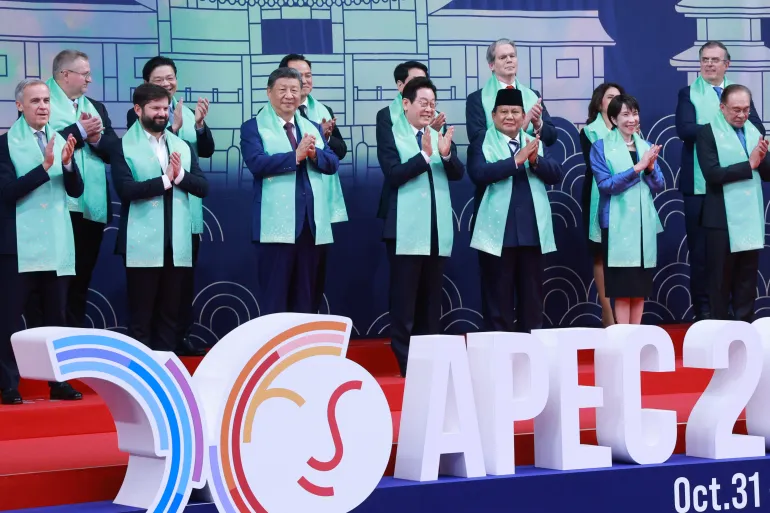
Leaders of the 21-member Asia-Pacific Economic Cooperation (APEC) forum concluded their annual summit on Saturday following a significant side-meeting between U.S. President Donald Trump and Chinese President Xi Jinping, where the two agreed to ease tensions in their ongoing trade war.
Truce Between Two Economic Giants
The breakthrough meeting ended months of escalating tariff threats and trade restrictions between the world’s two largest economies. Trump and Xi agreed to suspend planned tariff hikes, resume China’s purchase of U.S. agricultural goods, and initiate renewed dialogue on strategic sectors. The deal set a positive tone for the summit, which many described as a “reset moment” for global trade relations.
Regional Leaders Proclaim Common Goals
In their closing declaration, APEC leaders reaffirmed that “robust trade and investment are vital” for growth in the Asia-Pacific region. They pledged to strengthen cooperation on economic integration and address shared challenges, including artificial intelligence, demographic changes, and supply-chain resilience.
China Takes Spotlight, U.S. Presence Mixed
President Xi positioned China as a “champion of multilateralism and supply-chain stability,” highlighting Beijing’s growing influence in regional trade. Trump, however, left the summit earlier than scheduled, underscoring the shifting geopolitical balance in the Asia-Pacific region.
Questions Loom Over Trade Order and Reform
While the joint statement was seen as a step forward, it notably avoided direct references to the World Trade Organization or the phrase “free trade,” revealing underlying uncertainty about the future of global trade governance. Economists observed that the summit reflected a world at a “critical inflection point,” as protectionism and geopolitical rivalry threaten to reshape the global economic landscape.
What Comes Next
With China set to host APEC next year in Shenzhen and tensions temporarily de-escalated, attention will turn to how the new truce is implemented. Regional cooperation is expected to focus on rebuilding disrupted supply chains, ensuring trade stability, and preparing for technology-driven transformations in global industries.
Whether the breakthrough between Washington and Beijing leads to lasting economic stability remains one of the most important questions facing world leaders.













Leave a comment