

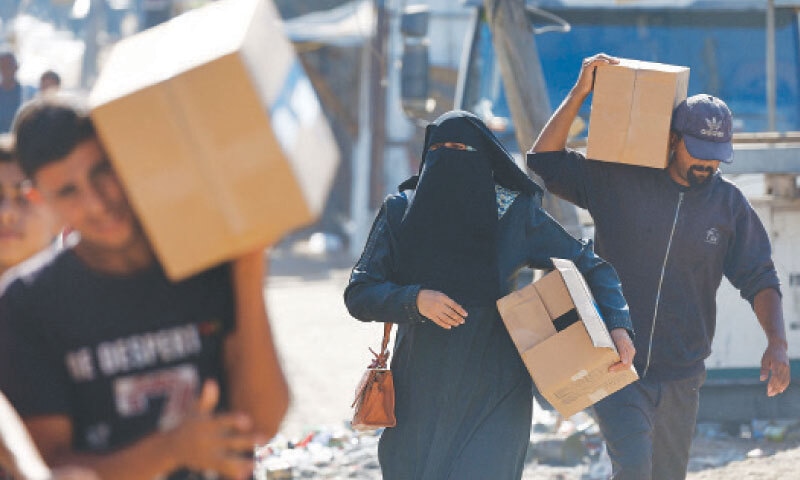
Following two years of relentless bombardment, much of Gaza now lies in ruins. A fragile ceasefire between Israel and Hamas has taken effect, offering a narrow window for humanitarian operations. Aid agencies emphasize that sustaining this truce is the only viable means of ensuring life-saving food reaches the millions of people facing acute hunger.
According to the World Food Programme (WFP), around 750 tonnes of food are entering Gaza daily since the ceasefire began — far below the agency’s target of 2,000 tonnes per day. The shortfall underscores the immense scale of Gaza’s humanitarian crisis. Since the truce went into effect, 530 WFP trucks have crossed into Gaza, delivering more than 6,700 tonnes of food — enough to feed nearly half a million people for two weeks. Despite this progress, the current supply meets only a fraction of the territory’s overwhelming needs.
The WFP now operates 26 food-distribution points across Gaza, compared with just five before the ceasefire. However, the agency’s target is to reach 145 distribution sites to cover the entire region. Most centers are concentrated in Gaza’s southern and central areas, while the northern region remains severely underserved and in desperate condition. Currently, trucks are entering only through the Kerem Shalom and Kissufim crossings, while northern routes remain closed. The continued blockage of these crossings makes it nearly impossible to deliver sufficient aid to the most affected populations.
WFP spokesperson Abeer Etefa stressed that the ceasefire is “vital” — potentially the only way to prevent famine in northern Gaza. She described residents as living in “survival mode,” rationing small amounts of food and saving portions out of fear that the truce might collapse. Both Israel and Hamas have accused each other of multiple violations since the ceasefire’s start eight days ago, underscoring its fragile and uncertain nature.
Israeli Prime Minister Benjamin Netanyahu announced that the Rafah crossing between Gaza and Egypt would remain closed “until further notice,” tying its reopening to Hamas handing over the bodies of Israeli hostages. Meanwhile, U.S. Vice President JD Vance, during his visit to Israel, ruled out any deployment of American troops in Gaza, saying Washington’s role would remain limited to coordination and logistical support rather than direct involvement.
The gap between actual deliveries (≈ 750 tonnes/day) and the target (≈ 2,000 tonnes/day) leaves thousands at risk of starvation. Northern Gaza remains the hardest to reach, with most aid concentrated in the south. The continuity of aid depends entirely on the truce’s survival — any renewed fighting would disrupt relief operations instantly. Closed crossings, hostage negotiations, and military dynamics all continue to shape the humanitarian situation.










Leave a comment