

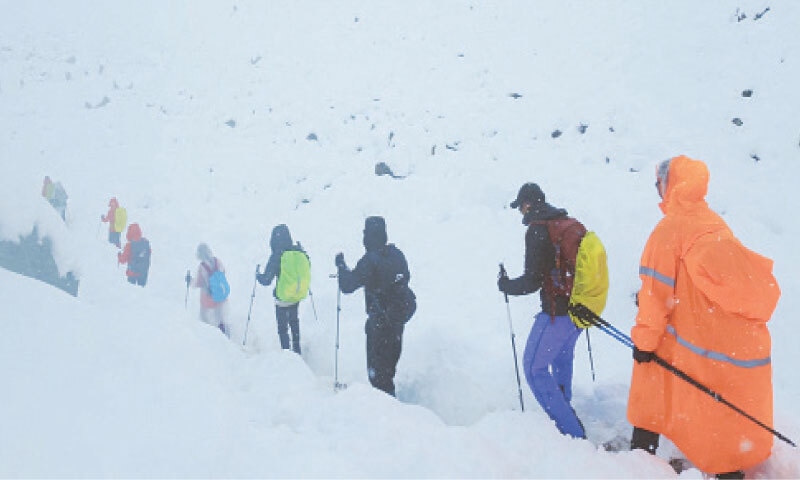
Hundreds of trekkers stranded by a sudden and unseasonal blizzard near the eastern slopes of Mount Everest in Tibet have been rescued after heavy snowfall and torrential rain battered the Himalayan region, Chinese state media reported on Monday.
According to China’s state broadcaster CCTV, more than 350 trekkers reached the township of Qudang, while contact was established with over 200 others still scattered across the high-altitude terrain. Local rescue teams continued to escort groups down in stages as extreme weather persisted across the area.
The trekkers, many of them Chinese nationals, were exploring the remote Karma Valley, which leads to the eastern Kangshung face of Mount Everest — a rarely visited yet striking part of the world’s highest mountain. The incident occurred during China’s week-long National Day holiday, when hundreds had ventured into the region for trekking expeditions.
One trekker, Chen Geshuang, part of an 18-member group that successfully descended to safety, described the ordeal as “terrifying.” “It was so wet and cold in the mountains, and hypothermia was a real risk,” she said. “The weather this year is not normal. Our guide said he had never experienced such conditions in October — it all happened so suddenly.”
Chen’s group reached Qudang on Sunday after enduring a night of blinding snowfall, thunder, and lightning. Local villagers greeted them with warm tea after their grueling descent.
State-backed Jimu News earlier reported that as many as 1,000 trekkers were initially trapped by the storm. Hundreds of local villagers, police, and emergency responders were mobilized to clear the deep snow and open blocked access routes.
The CCTV report said remaining trekkers would continue to be guided down under the supervision of local authorities. However, it did not specify whether all local guides and porters accompanying the expeditions had been accounted for.
The blizzard began late on Friday evening, bringing continuous snowfall through Saturday across the Karma Valley, which sits at an average altitude of 4,200 meters (13,800 feet). The valley, known for its rich vegetation and alpine forests, lies in stark contrast to Everest’s arid northern slopes and is sustained by meltwater from the Kangshung Glacier.
The severe weather, which forecasters say was fueled by a collision of moist monsoon air and cold winds from the Tibetan Plateau, has caused widespread chaos across the broader Himalayan region.
In neighboring Nepal, heavy rains triggered landslides and flash floods, killing at least 50 people since Friday. The eastern Ilam district, bordering India, was among the hardest hit, with 37 deaths reported from multiple landslides that buried homes and blocked roads.
Meanwhile, in a separate tragedy, a South Korean trekker died in Nepal after summiting Mera Peak (6,476 meters / 21,246 feet) on Saturday. According to Tulsi Gurung, president of the Nepal National Mountain Guides Association, the climber’s body was recovered by a rescue helicopter on Monday, while his guide was safely rescued.
October is traditionally one of the best months for trekking across the Himalayas, as clear skies and stable weather usually prevail after the Indian monsoon season. This year, however, has brought a sharp deviation from those norms — with climate scientists warning that global warming is increasingly disrupting seasonal weather patterns in high mountain regions.
The full scale of damage and potential casualties from the Tibet blizzard remains unclear, but officials said rescue and relief efforts will continue until all trekkers and guides are safely brought down from the mountains.
















Leave a comment