

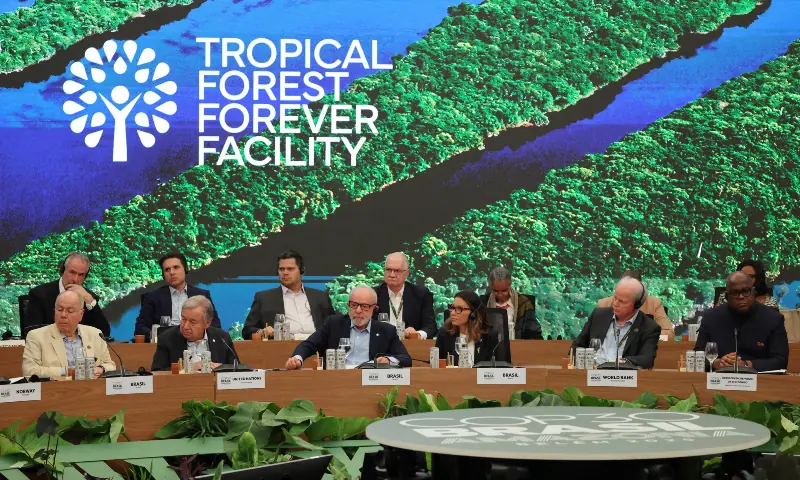
BELEM: UN Secretary-General Antonio Guterres delivered a searing rebuke to world governments on Thursday, accusing them of failing to honour their commitments to limit global warming to 1.5 degrees Celsius. His remarks came as Brazil welcomed leaders and officials from around the world for a high-profile climate summit in the run-up to the COP30 conference.
Addressing delegates, Mr Guterres warned that political leaders had become “captive” to fossil fuel interests, while major corporations continued to reap profits from practices that accelerate environmental destruction. “Too many corporations are making record profits from climate devastation, with billions spent on lobbying, deceiving the public and obstructing progress,” he said. “We can choose to lead — or be led to ruin.”
The summit is being held at a moment of growing alarm. Scientists now estimate that the world could cross the critical 1.5°C warming threshold as early as 2030—an event long viewed as the dividing line between manageable climate disruption and irreversible planetary damage. Despite the warnings, governments collectively pour more than $1 trillion annually into fossil fuel subsidies.
Outside the conference venue, indigenous groups staged vibrant demonstrations, singing, marching, and demanding stronger protections for the Amazon and other threatened ecosystems. A larger contingent of indigenous leaders travelling by river is expected to reach Belem next week after delays on their route.
Around 150 heads of state, regional leaders, and institutional representatives are participating in the two-day gathering. But the absence of the leaders of the United States, China, India, and Russia—four of the world’s heaviest polluters—has drawn considerable attention. Only the president of the European Commission is present, a dynamic some analysts suggest may enable more frank discussions among those in attendance.
Brazilian President Luiz Inácio Lula da Silva, hosting the summit, urged countries to commit to a “just transition” away from fossil fuels and restore degraded ecosystems. “We need a roadmap to undo deforestation, overcome fossil fuels and mobilise the resources needed for those aims,” he said. Lula also cautioned that extremist political movements were weaponising climate issues for electoral gain, locking societies into economic models that deepen inequality and environmental destruction.
Throughout the summit, leaders stressed equitable responsibility and financial fairness. China’s Vice Premier Ding Xuexiang called for strengthened unity and renewed commitment to multilateral climate frameworks. Britain’s Prince William described the current moment as “pivotal in human history,” emphasising the need for courage and collaboration. Chilean President Gabriel Boric condemned the resurgence of climate denial, referencing a recent misleading claim by the US president at the UN that contradicted established science.
The warnings from global leaders were reinforced by a bleak report from the UN’s weather and climate agency, released as the summit unfolded. The agency projected that this year will likely rank as the second- or third-hottest on record, marking more than a decade of exceptional heat. Rising concentrations of greenhouse gases, it said, are “locking in” additional warming for years ahead.
These trends, said WMO chief Celeste Saulo, make it “virtually impossible” to remain within the 1.5°C limit in the near term without temporarily breaching it. Under the 2015 Paris Agreement, nations committed to keeping global warming well below 2°C—and ideally, below 1.5°C—above pre-industrial levels.
Mr Guterres reminded leaders that the stakes could not be higher. Every year spent above the 1.5°C threshold, he warned, would amplify inequality, damage economies, and destroy ecosystems in ways that cannot be reversed.











Leave a comment