

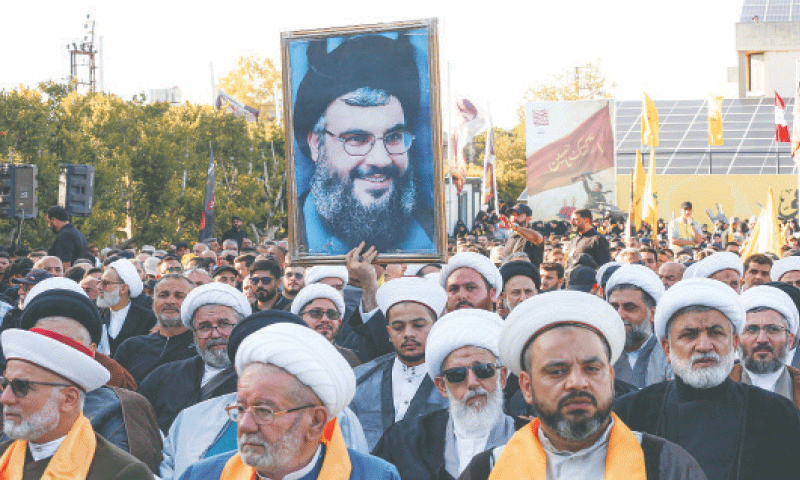
BEIRUT: Hezbollah leader Naim Qassem on Saturday firmly rejected growing domestic and international calls for the group to disarm, as thousands of supporters gathered near Beirut to mark one year since the killing of former Hezbollah chief Hassan Nasrallah in an Israeli airstrike. The commemorative event, held near the Beirut airport, served not only as a tribute but also as a platform for the group’s renewed defiance amid increasing pressure from Lebanon’s government and foreign powers.
Speaking at the rally, Qassem declared that Hezbollah would not surrender its weapons under any circumstances. “We will never abandon our weapons, nor will we relinquish them,” he told the crowd. “We are ready for martyrdom.” His speech was met with cheers and chants from supporters waving Hezbollah’s yellow flags alongside Lebanese, Palestinian, and Iranian banners.
Nasrallah, a charismatic figure and long-time face of Hezbollah, was killed on September 27, 2024, in a targeted Israeli strike on Beirut’s southern suburbs. The attack also claimed the life of the group’s second-in-command, Hashem Safieddine, and marked a turning point in Hezbollah’s military trajectory. In the months that followed, Israel carried out a sustained campaign that severely damaged the group’s arsenal and infrastructure.
The Lebanese government, emboldened by Hezbollah’s weakened position, has since moved to implement a disarmament plan drawn up by the Lebanese army, beginning in southern Lebanon — historically a Hezbollah stronghold. The group, once dominant in both military and political spheres, is now facing unprecedented pressure to relinquish its arms and integrate into state institutions.
Despite these developments, Hezbollah remains defiant. The anniversary event was attended by tens of thousands, many of whom voiced strong opposition to any attempt to strip the group of its weapons. Wisam Hodroj, a 51-year-old who traveled from Iraq to attend the memorial, said the recent war had only deepened the resolve of Hezbollah’s base. “What has happened since the last war has only increased our enthusiasm and strength,” he said. “We will not compromise on our weapons, and we will not hand them over.”
Similarly, Ali Jaafar, a 21-year-old university student, dismissed the disarmament plan as a fantasy. “Handing over the weapons is the dream of the enemies, the internal and external ones — but it will remain just a dream,” he said. Another attendee, 18-year-old Zahraa Haidar, said the community had endured immense hardship but would never surrender. “We went through difficult times… we have the resolve and the strength to never surrender our weapons and never submit to the enemy,” she told reporters.
Iranian security chief Ali Larijani, representing Hezbollah’s most powerful foreign backer, attended the ceremony. His presence underscored Tehran’s continued support for the group, even as its military capacity has suffered significant setbacks in recent months. Iran has long provided funding, weapons, and training to Hezbollah, which it sees as a strategic ally against Israel.
Hezbollah’s commemoration extended beyond Saturday’s rally. The group also organized symbolic gestures, such as projecting images of Nasrallah and Safieddine onto Beirut’s iconic Raouche Rock earlier in the week — an act carried out without government authorization. The display sparked criticism from Lebanese officials but was celebrated by Hezbollah’s base as a powerful statement of resistance.
In response to the escalating tensions, Lebanese President Joseph Aoun issued a carefully worded statement. While avoiding direct confrontation with Hezbollah, he emphasized the importance of national unity and the need for a singular military authority. “This painful anniversary should serve as a rallying point, reinforcing the belief that Lebanon’s salvation lies in having one unified state, one army, and constitutional institutions that protect sovereignty and uphold dignity,” he said.
From the international stage, Israeli Prime Minister Benjamin Netanyahu praised Lebanon’s recent moves toward disarmament but insisted that symbolic gestures were not enough. Speaking at the UN General Assembly, Netanyahu said, “We need more than words” and demanded verifiable actions to reduce Hezbollah’s military presence.
Hezbollah’s refusal to disarm continues to complicate Lebanon’s efforts to restore national stability. The group was the only militia allowed to retain its arms following the end of the Lebanese civil war in 1990, based on its continued fight against Israeli occupation in the south. Over time, however, Hezbollah expanded its military reach and political influence, and critics say it has effectively created a state within a state.
Tensions escalated dramatically in October 2023, when Hezbollah began launching rockets into northern Israel in support of Hamas during its conflict in Gaza. The situation deteriorated into a full-scale war by September 2024, resulting in widespread destruction on both sides. A ceasefire was eventually reached in November, but border tensions remain high, with Israel continuing to conduct regular military operations inside Lebanese territory and maintaining a presence at five disputed border points.
As Hezbollah marks the anniversary of one of its most significant losses, its leadership appears committed to continuing on a militant path — even as regional dynamics shift and domestic pressures mount. For now, the group shows no intention of disarming, reinforcing fears that Lebanon’s fragile peace could once again unravel.




Leave a comment