

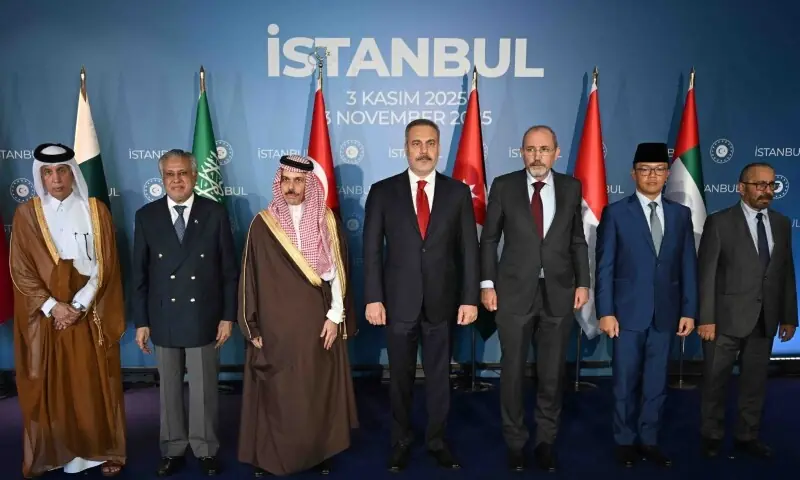
ISTANBUL: Foreign ministers from several Muslim-majority countries have called for the establishment of a UN-mandated international stabilisation force in Gaza, insisting that any post-war framework must ensure that Palestinians themselves govern and secure their territory.
The call came after a high-level meeting in Istanbul involving top diplomats from Türkiye, Qatar, Saudi Arabia, the United Arab Emirates, Jordan, Pakistan, and Indonesia. The talks, hosted by Turkish Foreign Minister Hakan Fidan, focused on defining the post-war order in Gaza following the fragile US-brokered ceasefire that came into effect on October 10.
Fidan said Türkiye’s position was clear — that the governance and security of Palestine should remain in Palestinian hands. “Palestinians should govern the Palestinians and ensure their own security. The international community should support this in the best possible way — diplomatically, institutionally, and economically,” he said.
He further emphasised that the proposed International Stabilisation Force (ISF) must operate under a mandate defined by the UN Security Council (UNSC) to ensure legitimacy and participation from member states. “It needs to be free from vetoes by any of the permanent members,” he warned, referring to the frequent use of the veto power by the United States to shield Israel.
According to diplomatic sources, Pakistan is also holding internal consultations regarding the possible deployment of troops to Gaza under the UN-backed framework. Officials say Islamabad, like Germany and Jordan, would prefer that any participation be strictly under UN command to maintain neutrality and legitimacy.
Washington is reportedly coordinating with regional and international partners to determine the composition of the force, while Israel remains opposed to Türkiye’s involvement due to Ankara’s longstanding ties with Hamas. Despite Israeli resistance, Türkiye has expressed its readiness to contribute to post-war security arrangements if the mission is endorsed by the UN.
Fidan revealed that he had recently met with Hamas’s chief negotiator Khalil al-Hayya, who expressed willingness to “hand Gaza to a committee of Palestinians” as part of an internal governance transition. He added that Türkiye hoped the reconciliation between Hamas and the Palestinian Authority would progress swiftly, strengthening Palestine’s international representation.
Meanwhile, Turkish President Recep Tayyip Erdogan said Hamas had shown full commitment to the ceasefire agreement and accused Israel of violating it. “It seems Hamas is quite determined to adhere to the agreement, while Israel’s record is very poor,” Erdogan said at an Organisation of Islamic Cooperation (OIC) summit in Istanbul.
Erdogan urged Muslim nations to take the lead in humanitarian aid and reconstruction efforts, saying, “The reconstruction plan prepared by the Arab League and the OIC should be implemented immediately. The Israeli government is doing everything possible to prevent this.”
In Islamabad, the Pakistan Foreign Office confirmed that Foreign Minister Ishaq Dar participated in the Istanbul deliberations alongside Arab and Islamic counterparts. A statement said the leaders discussed ways to ensure a lasting ceasefire, sustainable peace, and reconstruction in Gaza, while condemning Israeli ceasefire violations.
“Pakistan reaffirmed its principled stance for the establishment of an independent, viable, and contiguous State of Palestine based on pre-1967 borders, with Al-Quds Al-Sharif as its capital, in line with the UN and OIC resolutions,” the Foreign Office said.
As the conflict’s frontlines remain tense, the push by Muslim nations for a UN-backed stabilisation force reflects a growing desire for a coordinated international approach — one that combines Palestinian self-rule with global oversight to prevent further bloodshed and restore stability in Gaza.





Leave a comment