

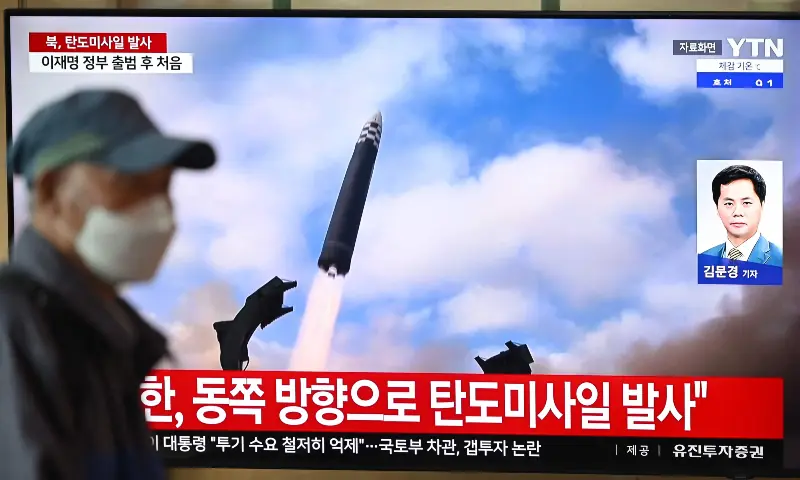
North Korea fired what appeared to be several short-range ballistic missiles early Wednesday, according to South Korea’s military. The launches come just a week before a major Asia-Pacific leaders’ summit in South Korea, raising regional tensions as diplomatic preparations intensify.
This marks Pyongyang’s first ballistic missile test since May and its first under South Korea’s newly elected President Lee Jae Myung, who has advocated for renewed engagement with the North. The timing of the launch — so close to an international gathering of top regional powers — underscores Pyongyang’s continuing defiance of United Nations Security Council resolutions banning such weapons.
South Korea’s Joint Chiefs of Staff said they detected multiple projectiles launched from an area near the North Korean capital, Pyongyang, in a northeasterly direction. The missiles reportedly traveled about 350 kilometers (217 miles) before falling inland. While no immediate damage or casualties were reported, the launch drew concern in Seoul, Washington, and Tokyo.
Diplomatic Stakes Rising Before APEC Summit
President Lee Jae Myung and U.S. President Donald Trump are expected to meet in Seoul next week during the Asia-Pacific Economic Cooperation (APEC) summit. Trump is also scheduled to hold bilateral talks with Chinese President Xi Jinping, setting the stage for a high-stakes round of diplomacy in the region.
Reports suggest that Lee and Trump have discussed the possibility of arranging a brief meeting with North Korean leader Kim Jong Un during Trump’s visit, though Pyongyang has yet to publicly respond. U.S. officials have also weighed the option of Trump visiting the Demilitarized Zone (DMZ) that separates the two Koreas, but no confirmation has been given.
Meanwhile, South Korea has temporarily suspended public tours of the Joint Security Area (JSA) at Panmunjom until early November, citing security concerns. Officials have not announced any concrete plans for a Trump–Kim encounter.
History of Trump–Kim Diplomacy
Trump and Kim Jong Un previously held three summits between 2018 and 2019, a historic series of meetings that momentarily thawed relations between Washington and Pyongyang. Both leaders exchanged personal letters that Trump described as “beautiful,” but their diplomacy ultimately collapsed over U.S. demands that North Korea dismantle its nuclear arsenal.
In a speech last month, Kim referred to his “fond memories” of Trump and said he would not rule out future talks if Washington dropped its insistence on denuclearization as a precondition. However, he reiterated that North Korea would “never abandon its nuclear weapons” merely to lift sanctions.
Experts Weigh In on Possible Meeting
Regional analysts remain divided over the likelihood and implications of another Trump–Kim encounter. Victor Cha, a senior fellow at the Center for Strategic and International Studies, noted that Trump’s unpredictable diplomatic approach could produce another surprise.
“It’s not inconceivable that Trump could reaffirm denuclearization as U.S. policy in Washington, then go to Panmunjom and acknowledge Kim as a nuclear power,” Cha said. “Even a short meeting might not be bad, considering everything else the U.S. is managing right now.”
Andrew Yeo, from the Brookings Institution, was more skeptical, pointing out that Trump’s packed schedule during his brief two-day visit to South Korea — especially the planned meeting with Xi Jinping — would leave little room for a separate session with Kim.
Missile Development and Regional Reaction
North Korea, which has long pursued nuclear weapons in defiance of international sanctions, has significantly advanced its missile capabilities over the past decade. The regime has tested a range of projectiles, from short-range systems to long-range intercontinental ballistic missiles capable of reaching the U.S. mainland.
Japan’s new Prime Minister Sanae Takaichi confirmed that the recent launch posed no direct threat to Japan’s security. Tokyo, she said, was closely coordinating with Washington and sharing real-time tracking data.
North Korea’s last ballistic missile test took place on May 8, when it fired multiple short-range missiles from its eastern coast. Earlier this month, the country showcased its newest intercontinental ballistic missile during a military parade attended by China’s premier — a signal of continued military cooperation between Pyongyang and Beijing despite Western condemnation.
The latest missile launch, timed so close to Trump’s East Asia visit, appears to be both a message of defiance and a calculated move to remain at the center of global attention as world leaders gather in Seoul.












Leave a comment