

Dazed and exhausted survivors of two powerful earthquakes in the southern Philippines woke up on Saturday to widespread destruction and uncertainty, after hundreds of aftershocks rocked the region overnight.
The twin quakes — measuring 7.4 and 6.7 in magnitude — struck off the coast of Mindanao island on Friday, sending terrified residents fleeing from their homes and prompting tsunami warnings that have since been lifted.
Authorities confirmed that at least eight people were killed, while many others were injured as buildings crumbled and infrastructure suffered damage. The Office of Civil Defence said no one was reported missing, and that initial assessments showed “minimal infrastructure damage.” Road-clearing operations were already underway, with most highways now passable, officials said.
A night of fear and destruction
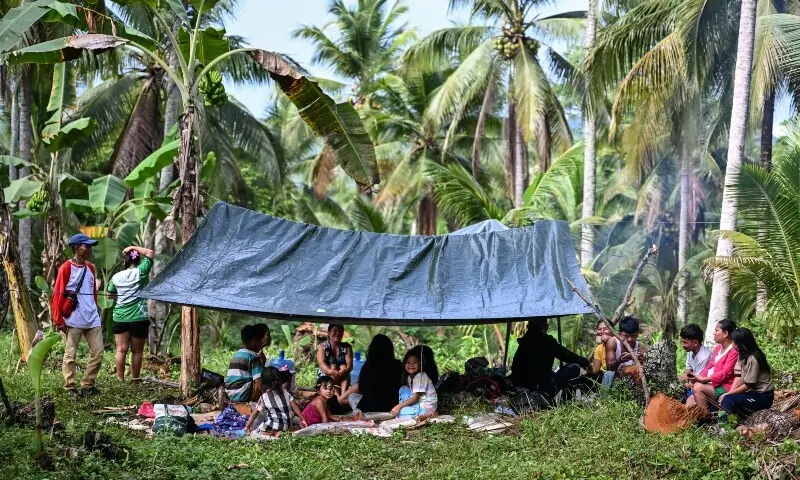
In Manay, a coastal municipality of 40,000 people, residents spent the night in makeshift shelters — sleeping outdoors in parks, along roadsides, or under tarps — fearing deadly aftershocks. “Our small house and store were destroyed,” said local resident Ven Lupogan. “We have nowhere to sleep. There’s no electricity. We have nothing to eat.”
The government hospital in Manay was among the worst-hit structures, with engineers declaring it unsafe. Patients were wheeled out of the damaged building and treated outside, while medical staff worked in improvised conditions.
Nearby shopkeepers swept up broken glass and tried to restore their stores, while others searched through debris to salvage belongings.
Vilma Lagnayo, whose home collapsed during the quakes, said her family was left homeless. “Reconstructing our home is difficult now… money is a problem,” she said, echoing the desperation felt across the affected communities.
Aftershocks continue to shake Mindanao
The Philippine Institute of Volcanology and Seismology (Phivolcs) reported more than 800 aftershocks since the first major quake, warning that tremors could continue for weeks. The constant shaking has kept residents on edge, many of whom are too afraid to return indoors.
President Ferdinand Marcos Jr. has directed all relevant government agencies to continue relief and recovery operations. “The President’s paramount concern is the safety and well-being of our people in the earthquake-struck areas,” said Presidential Communications Office Secretary Dave Gomez.
A country constantly tested by nature
The back-to-back earthquakes come less than two weeks after a 6.9-magnitude quake devastated the central island of Cebu, killing at least 75 people and destroying tens of thousands of homes.
The Philippines sits on the Pacific “Ring of Fire,” a zone of frequent seismic and volcanic activity that stretches from Japan through Southeast Asia and across the Pacific. The country is no stranger to deadly earthquakes — including the 1976 Mindanao quake, which triggered a tsunami that killed or left missing more than 8,000 people in what remains the nation’s deadliest natural disaster.
In the coastal town of Mati, about two hours from Manay, residents held a funeral wake under the looming threat of more aftershocks. “In case something happens, they will carry the body using a ‘tora-tora’,” said local resident Margarita Mulle tearfully, referring to the small tractor-drawn carts commonly used for transport in rural areas.
As rescue and relief teams continue to reach affected areas, the people of Mindanao are beginning the difficult task of rebuilding — with resilience, fear, and hope interwoven in every shaken community.













Leave a comment