

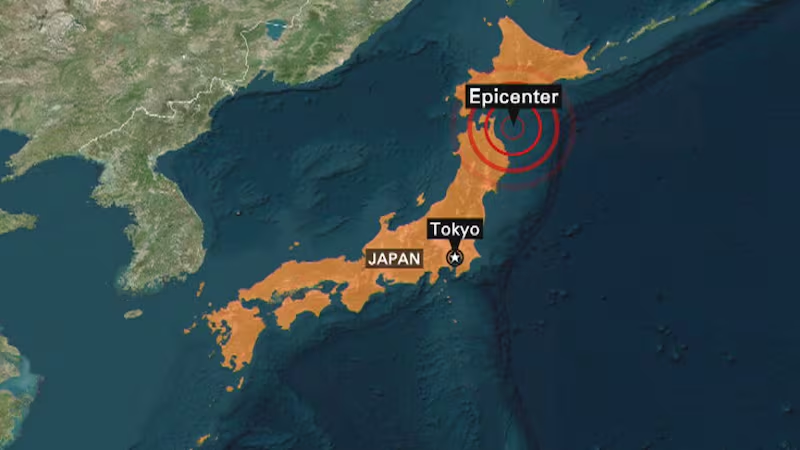
A powerful earthquake struck off Japan’s northern Pacific coast on Monday, sending tremors across several prefectures and prompting an immediate tsunami warning. The Japan Meteorological Agency reported multiple tsunami waves hitting coastal areas, while local media indicated that injuries and property damage had begun to emerge.
The United States Geological Survey recorded the quake as a magnitude 7.6 event, occurring at 1415 GMT near Misawa in Aomori Prefecture at a depth of 53 kilometres (33 miles). Japan’s meteorological agency issued an urgent tsunami alert shortly afterward, with the first wave reaching a port in Aomori at 11:43 pm (1443 GMT). Subsequent waves measuring up to 50 centimetres (20 inches) arrived along the coastline, though authorities warned that larger waves could still follow.
Public broadcaster NHK reported injuries in the city of Hachinohe, where a hotel employee said damage had caused harm to some residents. Live footage from the area showed streets littered with shattered glass, and many locals evacuated their homes and sought refuge in the city hall. The quake was also felt in Sapporo, the northern capital of Hokkaido, where smartphone alert alarms rang across the city. An NHK reporter in Hokkaido described intense horizontal shaking lasting around 30 seconds—strong enough to prevent him from standing.
Officials had earlier warned that tsunami waves as high as three metres (10 feet) could hit Japan’s Pacific coastline. Chief Cabinet Secretary Minoru Kihara urged residents to remain in safe locations, stressing that multiple waves could follow the initial one and that later waves can sometimes be higher. He added that no abnormalities had been reported at two nuclear power plants in northern Japan, although inspections at several facilities were ongoing.
Memories of the 2011 catastrophe—when a 9.0 magnitude earthquake triggered a devastating tsunami and the Fukushima nuclear meltdown—remain vivid in Japan. Shortly after Monday’s quake, Tohoku Electric Power announced that its Higashidori nuclear plant in Aomori and the Onagawa plant in Miyagi had shown no irregularities.
Japan’s location on four major tectonic plates along the Pacific “Ring of Fire” makes it one of the most seismically active countries in the world, experiencing roughly 1,500 quakes annually. While most are minor, their impact depends heavily on depth and proximity to populated areas. Although predicting earthquakes remains extremely difficult, a government panel earlier this year raised the estimated probability of a major rupture in the Nankai Trough within the next 30 years to 75–82 percent. Government modelling released in March warned that such a “megaquake” could result in up to 298,000 deaths and as much as $2 trillion in economic losses.
Monday’s quake served as another reminder of Japan’s constant vulnerability to seismic hazards, as authorities worked late into the night to assess damage, protect residents and monitor ongoing tsunami risks.











Leave a comment