

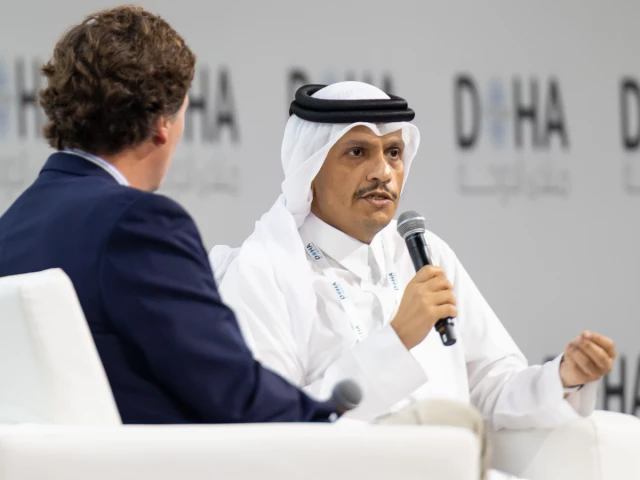
In a region beset by conflicts ranging from Afghanistan to Gaza, Qatar on Sunday emphasised the importance of inclusive political engagement, including with non-state actors, as the only viable path to lasting peace. Speaking at the 23rd edition of the Doha Forum, Qatari Prime Minister and Foreign Minister Sheikh Mohammed bin Abdulrahman bin Jassim Al Thani said that sustainable conflict resolution requires direct communication with all parties, including armed groups often excluded by Western governments.
Moderated by US journalist Tucker Carlson, Sheikh Mohammed stressed that crises in Afghanistan, Palestine, and elsewhere cannot be resolved if key actors on the ground are ignored. “You cannot resolve or reach a solution if you have no one speaking to non-state actors,” he said, noting that Qatar has consistently used this principle in its mediation efforts, including facilitating dialogue between Pakistan and the Afghan Taliban regime.
Highlighting Qatar’s long-standing role as a neutral mediator, Sheikh Mohammed cited examples such as Qatar’s decade-long engagement with Hamas, initiated at the request of the United States to provide a reliable channel for communication, ceasefire negotiations, and humanitarian aid delivery in Gaza. He similarly pointed to the Taliban’s political office in Doha, established in 2013 during the group’s conflict with the US and the Afghan government, which ultimately contributed to the 2020 Doha Agreement and the US withdrawal from Afghanistan.
Addressing criticisms that Qatari humanitarian funds in Gaza were diverted to Hamas, the Prime Minister said all aid and support went directly to civilians and followed a transparent process monitored by the United States. He noted that Israel itself facilitated the distribution of these funds. Sheikh Mohammed criticised domestic political actors who, he claimed, distorted Qatar’s role for short-term political gain, stressing that Qatar’s mediation has led to tangible outcomes including multiple ceasefires, humanitarian pauses, hostage releases, and evacuation arrangements.
Sheikh Mohammed also condemned the Israeli strike on Qatari territory in September, describing it as a “blatant breach of diplomatic norms” and “unethical,” noting that US President Donald Trump had expressed surprise and frustration over the incident. On the humanitarian situation in Gaza, he reiterated Qatar’s commitment to aid but stressed that the responsibility for reconstruction must lie with those who caused the damage. He criticised what he described as a “double standard” in the international community, comparing calls for Russia to rebuild Ukraine with the reluctance to hold Israel accountable for Gaza’s reconstruction.
The Prime Minister highlighted that, according to UN estimates, 92 percent of residential buildings in Gaza have been damaged or destroyed, generating up to 60 million tonnes of rubble, and warned that rebuilding could take decades. He strongly opposed any attempts to forcibly displace Palestinians, stating that they should not be treated as people who can be “reshuffled or relocated” at the convenience of regional powers, and affirmed their right to remain in their homeland.
The 23rd Doha Forum brought together over 5,000 delegates from 162 countries, including presidents, prime ministers, foreign ministers, and global policy experts, to discuss issues such as conflict resolution, humanitarian crises, governance, and economic instability, with Qatar positioning itself as a key mediator in some of the region’s most protracted conflicts.



Leave a comment