

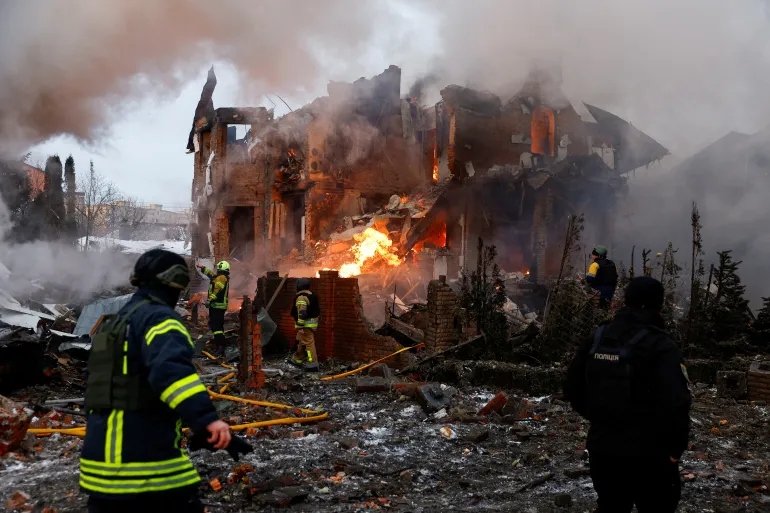
KYIV, Ukraine – Four years after the full-scale Russian invasion of Ukraine began on February 24, 2022, ordinary Ukrainians continue to endure the human and material toll of the conflict, even as frontlines remain largely frozen.
According to Al Jazeera, Hennady Kolesnik, a 71-year-old retired welder told that these have been “the worst and longest years” of his life. In the early days of the war, he and millions of Ukrainians feared Kyiv would fall, along with a third of the country lying on the eastern bank of the Dnipro River. Russian forces, including elite airborne units and motor rifle brigades, occupied the north of Kyiv, while Kremlin supporters claimed the capital would be captured “within three days.”
Months later, Ukrainians celebrated the withdrawal of Russian troops from around Kyiv and northern Ukraine. “We were ecstatic about what we’d regained,” Kolesnik said, reflecting on the relief felt across the capital. The pensioner, recovering from pneumonia he feared might be fatal during extended power outages and central heating disruptions amid sub-zero temperatures, added: “But we’re still standing, and that’s the most important thing in a fight.” His wife Marina, 70, echoed his sentiment: “Nobody expected us to last that long, and we’re still here.”
Despite Ukraine’s 2023 counteroffensive, Russian troops have maintained their “land bridge” connecting western Russia to annexed Crimea, advancing slowly amid significant losses. Last year, Russia gained less than 5,000 square kilometers, or about 0.8 percent of Ukraine’s territory. Overall, Moscow controls roughly 19 percent of the country, according to Ukrainian officials and Western analysts.
Experts describe the frontlines as frozen, likening them to World War I trench warfare. Nikolay Mitrokhin, a researcher at Germany’s Bremen University, told Al Jazeera: “So far, Russia doesn’t have enough forces or new technologies for a decisive and successful advance, but it can still squander thousands of lives.”
Russian forces have faced dual setbacks in communications this month. Elon Musk’s SpaceX shut down smuggled Starlink satellite internet terminals used by Russian troops, while efforts to block the Telegram messaging app further disrupted coordination. Ukrainian forces counterattacked, reclaiming approximately 200 square kilometers in the eastern Zaporizhia and Dnipropetrovsk regions.
However, pressures remain acute in other frontline areas. Russian drones equipped with optic fiber resistant to jamming have begun targeting heavily fortified towns in southeastern Donetsk region. “It has gotten a lot noisier. There are more outages; some locals are panicking,” said Sviatoslav, a Ukrainian serviceman stationed in Kramatorsk, who spoke on condition of anonymity due to wartime protocols. Moscow demands Kyiv surrender Kramatorsk and surrounding areas, covering about 1,000 square kilometers.
Energy infrastructure remains a critical vulnerability. Mitrokhin warned that while Ukraine maintains its frontlines, the functionality of its energy system “is hanging by a thread,” with further Russian strikes potentially affecting both civilian life and military resilience. A January survey by the Kyiv International Sociology Institute (KMIS) found that 88 percent of Ukrainians believe Russian attacks are designed to force the country to capitulate, yet two-thirds insist the armed forces should fight “as long as it takes.”
Despite the prolonged conflict, Ukrainians continue to adapt psychologically to the war. Svetlana Chunikhina, vice president of the Kyiv-based Association of Political Psychologists, said that although rates of depression, anxiety, and chronic stress have risen, the population has largely maintained functionality. “People adapt – including through depression – to the war’s horrible circumstances; people keep functioning,” she noted. Ukrainians still hold hope for a better future even amid the ongoing devastation and frozen frontlines.




Leave a comment