

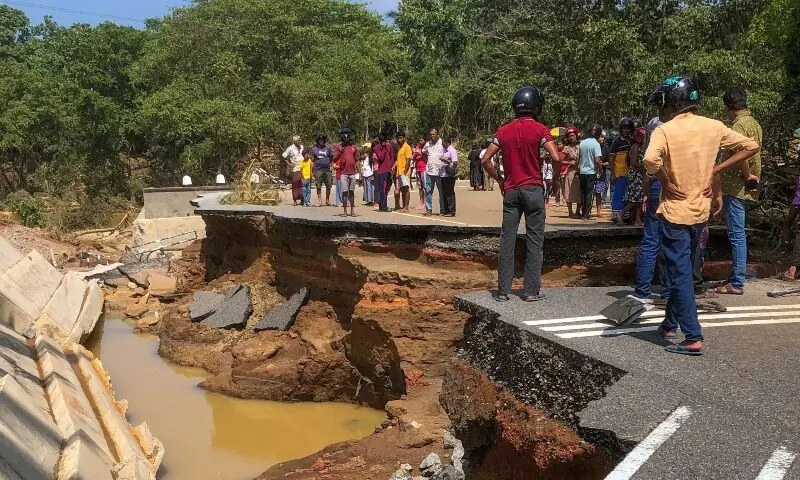
The death toll from floods and landslides caused by Cyclone Ditwah surged to 334 on Sunday, Sri Lanka’s Disaster Management Centre (DMC) reported, with nearly 400 people still missing and over 1.3 million affected nationwide.
Officials described the disaster as the worst to strike the island in two decades, with the central region facing the most severe impact. Relief teams have been working to clear roads blocked by fallen trees and mudslides, slowly revealing the full scale of destruction.
President Anura Kumara Dissanayake, who declared a state of emergency in response to the disaster, said in a national address that Sri Lanka is confronting “the largest and most challenging natural disaster in our history.” He promised to rebuild with international support, stating: “Certainly, we will build a better nation than what existed before.”
The current flooding crisis is considered the deadliest since the 2004 Asian tsunami, which killed around 31,000 people and left over a million homeless. While rains have eased across most of Sri Lanka, low-lying areas of the capital, Colombo, remain submerged, and authorities are preparing for a major relief operation.
Tragedy struck further when a Bell 212 helicopter carrying food for patients stranded at a hospital north of Colombo crashed into a river on Sunday evening. All five crew members survived and were taken to a nearby hospital. Another helicopter sent from India rescued 24 people, including a pregnant woman and a man in a wheelchair, from the central town of Kotmale, approximately 90 kilometers northeast of Colombo.
The Sri Lanka Air Force reported additional rescues, including two infants and a 10-year-old child from a hospital in the northern town of Chilaw, which was submerged on Saturday. Authorities warned that floodwaters in Colombo would take at least a day to recede, though dry weather was forecasted as Cyclone Ditwah moved north toward India.
Residents described the devastation in vivid terms. Selvi, 46, from the Colombo suburb of Wennawatte, said: “My house is completely flooded. I don’t know where to go, but I hope there is some safe shelter where I can take my family.”
In the town of Manampitiya, 250 kilometers northeast of Colombo, receding waters revealed extensive destruction. S. Sivanandan, 72, a local resident, said: “Manampitiya is a flood-prone town, but I have never seen such a volume of water.” As rescue operations continue, authorities are emphasizing the urgent need for relief supplies and temporary shelters for thousands of families displaced by the floods and landslides.











Leave a comment