

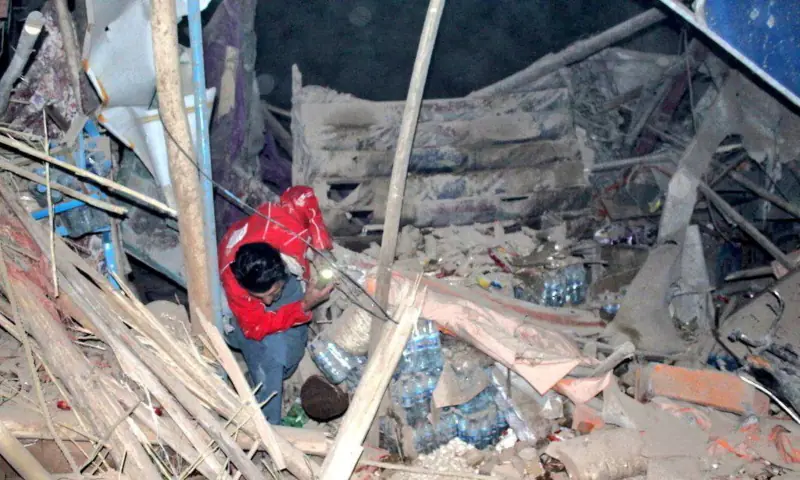
KABUL: A powerful earthquake struck northern Afghanistan overnight, killing at least 20 people and injuring hundreds more, officials said on Monday. The 6.3-magnitude quake hit near the city of Mazar-i-Sharif, just months after another devastating tremor that left the country struggling to recover.
According to the US Geological Survey (USGS), the earthquake struck at a depth of 28 kilometres (17 miles), with the epicentre located close to Mazar-i-Sharif — a densely populated city of over 523,000 residents. The tremor, which shook homes and flattened buildings, sent residents rushing into the streets in panic.
In the village of Tashqurghan, survivor Ahmad Khan told AFP that the quake had destroyed most homes. “All the houses were struck and people were hurt,” he said, appealing to authorities: “We’re asking the government to help with reconstruction.”
Provincial health officials confirmed that at least seven people were killed and 150 injured in the Samangan province, one of the hardest-hit regions. “The toll was based on hospital reports collected as of Monday morning,” said Samim Joyanda, spokesperson for the Samangan health department, warning that casualties could rise as rescue operations continue.
The Taliban defence ministry stated that Balkh and Samangan provinces suffered the most damage, with several fatalities and widespread destruction. “Military rescue and emergency assistance teams reached the area immediately and began operations to rescue people, transport the injured, and assist affected families,” the ministry said.
Health ministry spokesperson Sharfat Zaman confirmed that all nearby hospitals have been placed on emergency standby, and rescue teams remain active in the affected regions. “Health teams have arrived in the area, and the number of dead and injured may rise,” he said.
The USGS issued an “orange alert” through its PAGER impact system, indicating that the disaster is potentially widespread and that significant casualties are likely. Past earthquakes with this alert level have required a national-level response, highlighting the seriousness of the situation.
Afghanistan’s geography makes it particularly vulnerable to seismic activity as the country sits atop two major active fault lines. The nation frequently experiences devastating earthquakes due to poor infrastructure and lack of preparedness.
In August, another powerful quake and subsequent aftershocks in southeastern Afghanistan killed more than 2,200 people and injured thousands, underscoring the ongoing vulnerability of the war-torn country.
Officials also reported that the earthquake damaged parts of the historic Blue Mosque — the holy shrine in Mazar-i-Sharif — one of the most revered landmarks in Afghanistan’s Balkh province.












Leave a comment