

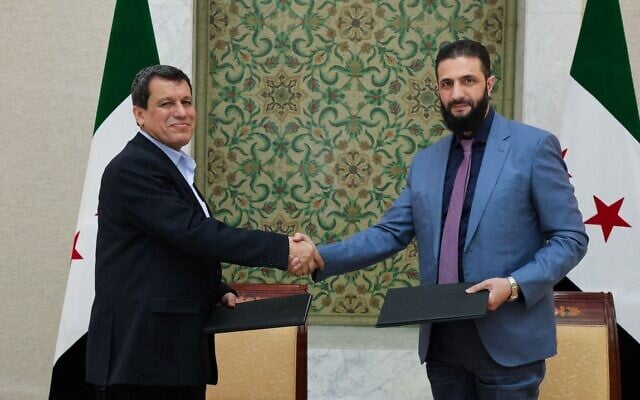
DAMASCUS: Syria has announced a comprehensive ceasefire with Kurdish forces following a meeting between President Ahmed al-Sharaa and Kurdish leader Mazloum Abdi after days of deadly clashes in Aleppo. The move comes as part of renewed efforts to ease tensions between Damascus and the Kurdish administration, which controls large parts of northern and northeastern Syria. The talks, attended by U.S. officials, mark a significant step toward reconciliation, though deep political differences remain unresolved.
Syrian Defence Minister Murhaf Abu Qasra confirmed the agreement in a statement on X, saying both sides had agreed to halt hostilities on all fronts and establish points for military deployment in the north and northeast. He added that implementation would begin immediately. A government source said the meeting followed a direct conversation between President Sharaa and Mazloum Abdi—the first such encounter since July—where they discussed security concerns related to the delayed March 10 agreement on integrating Kurdish civil and military structures into the Syrian state.
U.S. envoy for Syria Tom Barrack and Admiral Brad Cooper, head of the U.S. Central Command, were also present during the discussions. Barrack later said that he and Cooper had visited northeast Syria for “substantive conversations” with Kurdish representatives. Abdi noted that their discussions focused on political integration, preserving Syria’s territorial unity, and maintaining cooperation against the Islamic State group.
The ceasefire followed intense clashes in Aleppo’s Kurdish-majority districts of Sheikh Maqsud and Ashrafiyeh, where exchanges of fire between Syrian forces and Kurdish units left at least one soldier and one civilian dead. State television reported that Kurdish fighters had targeted security checkpoints, while the Syrian Observatory for Human Rights said government forces used explosive drones and heavy weapons. Residents described scenes of fear and displacement as families fled the fighting. “We decided to leave our home this morning. We saw many families fleeing Sheikh Maqsud and Ashrafiyeh,” said 67-year-old Sinan Rajab Basha.
The confrontation highlighted the fragile relationship between the central government and Kurdish authorities, who have long sought a decentralized system granting them autonomy. The new Islamist-led government in Damascus, which came to power after Bashar al-Assad’s ouster last year, has rejected Kurdish demands, insisting on maintaining centralized control. Kurdish leaders have also criticized the country’s temporary constitution for ignoring Syria’s ethnic and religious diversity, and noted that Kurdish-held provinces such as Raqqa and Hasakeh were excluded from last weekend’s parliamentary elections.
Aleppo city remains under government control, but several northern districts, including Sheikh Maqsud and Ashrafiyeh, continue to be administered by Kurdish security forces. Despite a disengagement agreement earlier this year, tensions have persisted, with each side accusing the other of violations. The Kurdish-led Syrian Democratic Forces denied attacking government positions, claiming instead that pro-Damascus militias had besieged Kurdish neighborhoods and tried to advance with tanks.
The ceasefire agreement offers a brief respite after a week of bloodshed and displacement, but analysts warn that the underlying political rifts remain unresolved. Both sides appear willing to avoid further escalation, yet mutual mistrust and competing visions for Syria’s future could once again threaten the fragile peace.









Leave a comment