

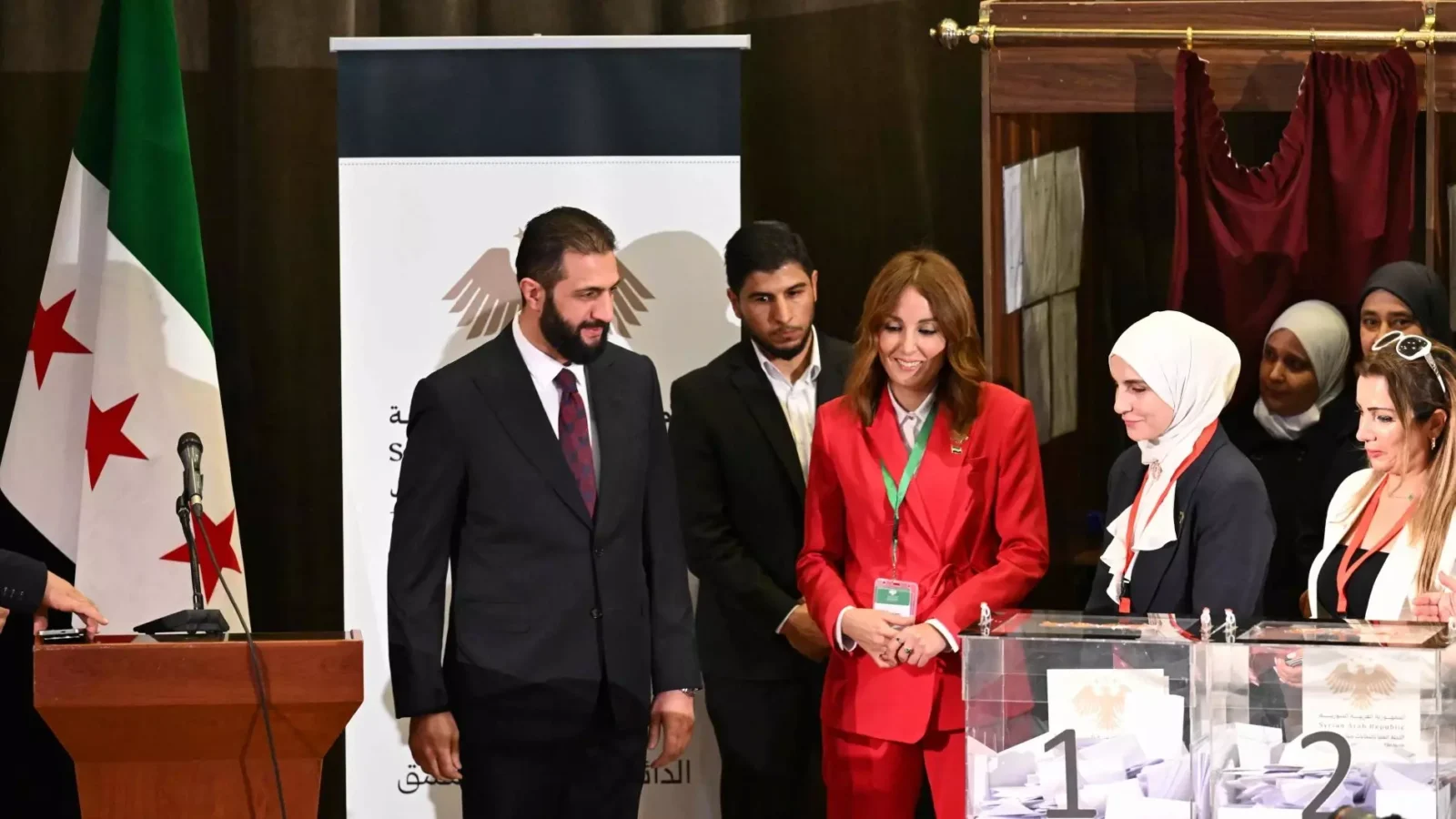
DAMASCUS: Syria’s first transitional parliament since the ouster of longtime president Bashar al-Assad has drawn criticism for its lack of inclusivity, with women and minorities securing only a handful of seats, according to results announced on Monday.
The new 210-member assembly, which will serve for a renewable 30-month term, was elected through an indirect process on Sunday. Several thousand members of local committees cast ballots to select representatives, in an exercise many opposition voices and observers described as tightly controlled and lacking transparency.
Interim President Ahmed al-Sharaa, who assumed office after Assad’s removal, is tasked with appointing 70 members of the legislature. The remaining two-thirds were chosen by local committees—bodies appointed by an electoral commission that itself was formed by Sharaa’s administration.
Low representation of women and minorities
Electoral commission spokesperson Nawar Najmeh said during a press conference that women accounted for just four percent of the 119 elected members. “This is not proportionate to the status of women in Syrian society or their contributions to political, economic, and social life,” Najmeh said.
Earlier, the commission had stated that women comprised 14 percent of the more than 1,500 candidates. Only two Christians won seats, which Najmeh described as “weak considering the proportion of Christians in Syria.” He suggested that the president’s appointees might help “compensate” for some underrepresented groups but ruled out the adoption of any quota system.
Syrian-American Henry Hamra, the first Jewish candidate to run in decades, was not elected.
Excluded regions and delayed ballots
Elections were postponed in Syria’s Kurdish-held northeast and the Druze-majority Sweida province in the south, both areas outside Damascus’s control. Sweida witnessed sectarian violence in July, while negotiations to integrate Kurdish-administered regions under a March 10 deal have stalled.
Under that agreement, Kurdish civil and military institutions were to be incorporated into the Syrian state by the end of the year. Najmeh said supplementary ballots would be held to fill the assembly’s vacant seats but acknowledged that “we are unable to set timetables for Raqa and Hasakeh due to delays in implementing the March 10 agreement.”
New legislature faces challenges
Political and rights activist Nour al-Jandali, who won a seat in Homs, said the new assembly carries a heavy responsibility in shaping Syria’s post-conflict future. “We must rebuild a state based on freedom, citizenship, and justice,” she said, adding that “women must have a real and active role in policymaking.”
The transitional parliament operates under a temporary constitution issued in March. It will assume legislative powers until a permanent constitution is approved and new nationwide elections are held, marking a crucial step in Syria’s ongoing attempt to redefine its political system after more than a decade of war and authoritarian rule.





Leave a comment