

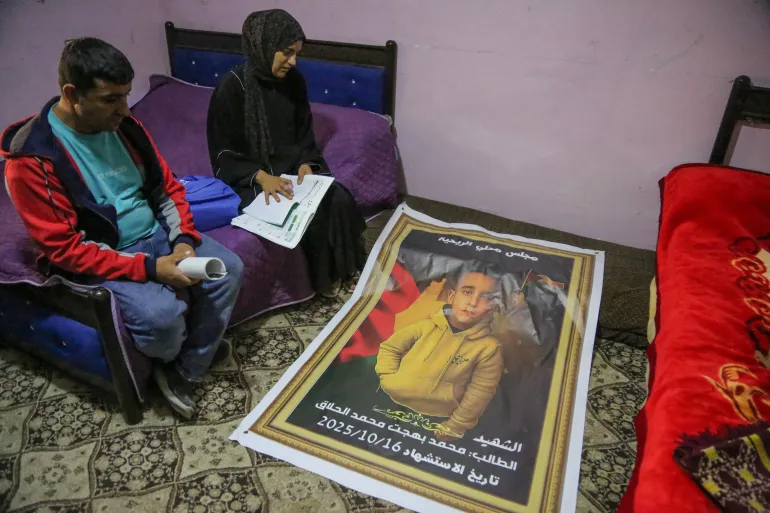
In the village of Al-Rihiya, just south of Hebron in the occupied West Bank, nine-year-old Muhammad al-Hallaq was killed on October 16 while playing football with friends. His death has left his family shattered and grappling with profound loss.
On the morning of the shooting, Muhammad woke prepared for his day: his mother Alia had packed him breakfast and even included extra slices of pizza for his friends. He’d returned home with a new backpack, eager to take it to school after the weekend. He spent time watching birds, playing with olives, and then headed outdoors to kick a ball — but he never returned.
His family first heard the news via phone call: Alia’s uncle asked whether there’d been clashes in the area. Instinctively, she screamed out her son’s name. His eldest sister Mais, aged 14, rushed outside after hearing the gunfire. They were initially told he’d been injured, and that a bullet would be removed. But as whispers spread, the truth became clear: Muhammad had died in surgery after his heart monitor flatlined.
“Muhammad was gone — and with him, everything good,” his mother said.
Questions Over Use of Lethal Force and Lack of Accountability
According to the United Nations Human Rights Office, Muhammad is the 1,001st Palestinian killed by Israeli forces or settlers in the West Bank since October 7, 2023 — among them 213 children.
The UN said that the high number of killings, the use of force that appears unlawful, and the near-complete absence of investigations suggest a disturbing pattern — “use of lethal force as a tool to control and repress Palestinians, rather than as a last resort.”
An initial statement from the Israeli military claimed the shooting was in response to suspects throwing rocks, though no local reports confirm any rock-throwing involving Muhammad or his friends. Israeli media later reported that a preliminary investigation found the shooting “deviated from the rules of engagement” and involved “improper use of weaponry.”
The Void Left Behind in a Fragile Household
Muhammad was the third of five siblings — his older sister Mais, his brother Jaddi (12), his sister Sila (6), and his youngest brother Elias (4). His absence is deeply felt in every corner of the home.
The white robe he wore for Friday prayers still lies neatly folded beside his bed; his books remain stacked beside the new backpack he never took to school. His father Bahjat wanders the room, touching his bed and breathing in the scent of his clothes.
“His passing left a huge void,” his father said quietly.
Mais described her brother not only as a sibling but a best friend: he would ask her to tutor him after school, stay beside her when she was afraid of the dark, and always made her laugh. Now, their home feels haunted by his absence.
A Community in Shock, and the Larger Reality
The killing has shocked the village of Al-Rihiya, where Israeli military raids and settler violence are frequent. Families say that soldiers rarely face accountability for civilian deaths in the West Bank.
Muhammad’s family and classmates continue to mourn — his friends still talk about him, his mother points to his empty bed and says softly:
“They killed his childhood.”
The tragedy has come to symbolize a broader crisis: in a decades-old conflict, Palestinian children continue to lose their lives, often without justice, investigation, or international action.





Leave a comment