

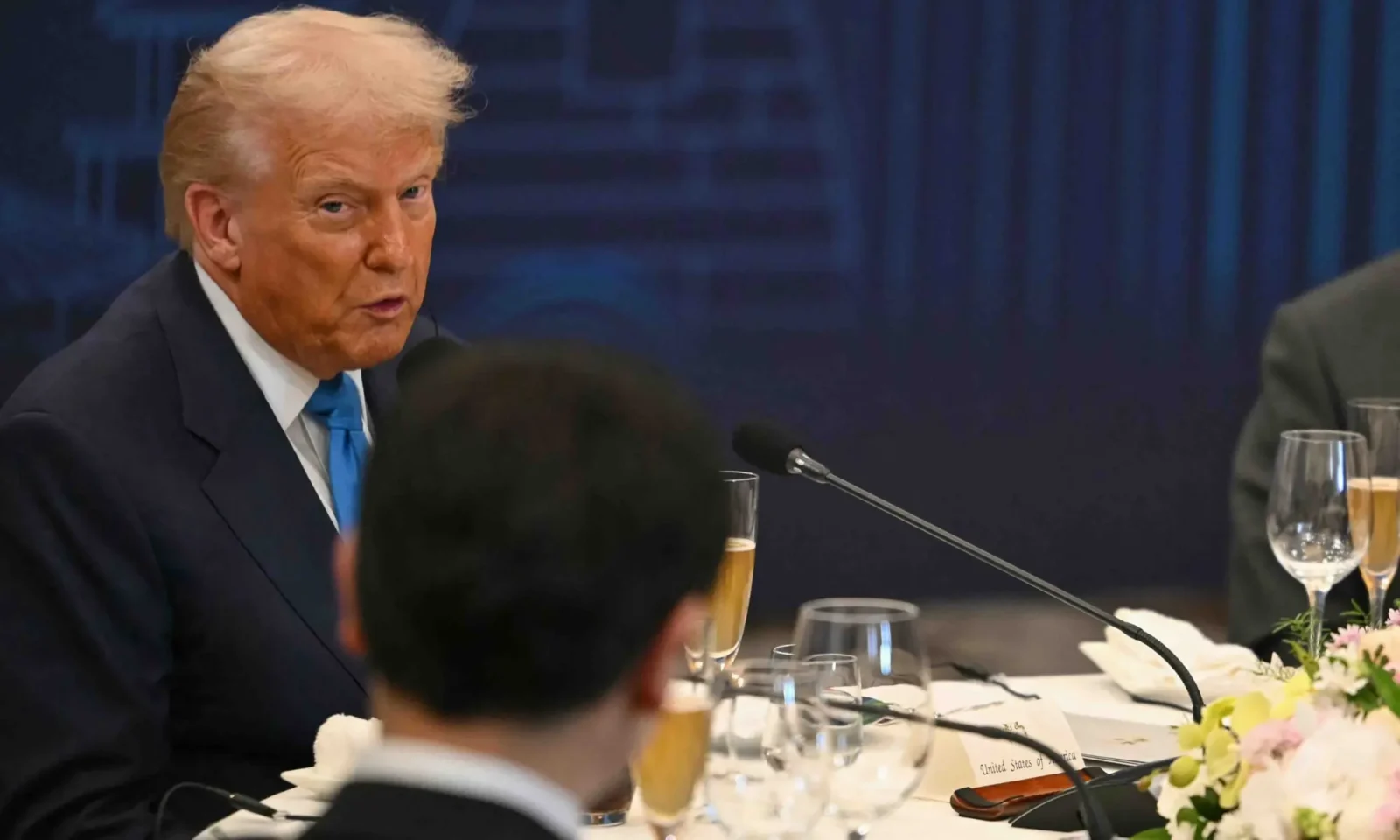
US President Donald Trump has ordered the Pentagon to “immediately resume testing” of American nuclear weapons, ending a pause that has lasted more than three decades.
The announcement came through a post on his social-media platform while Trump was traveling to a meeting with Chinese President Xi Jinping in Busan, South Korea. He stated that other nations were “conducting testing programs,” insisting that the United States must “start testing again on an equal basis.”
Trump specifically mentioned Russia as being “second” and China as “a distant third… but will be even within five years,” underscoring his belief that Washington should reassert its dominance in nuclear deterrence.
The declaration has sparked global concern among non-proliferation advocates and international organizations. The Comprehensive Nuclear-Test-Ban Treaty Organization (CTBTO) warned that any explosive nuclear test would be “harmful and destabilizing” for global security.
However, it remains unclear whether Trump’s directive refers to full-scale explosive nuclear tests or to delivery-system and flight tests involving nuclear-capable weapons. This ambiguity has added to strategic uncertainty and alarm among defense analysts.
Major nuclear powers, except North Korea, have refrained from explosive nuclear testing for decades — the United States last tested in 1992, Russia in 1990, and China in 1996. Resuming such tests would mark a historic policy reversal and could reignite an arms race among the world’s nuclear powers.
In response, Russia warned that if the United States abandons its moratorium on nuclear tests, Moscow “will act accordingly.” This statement reflects growing tensions between Washington and Moscow amid already strained relations over arms-control treaties and geopolitical rivalries.
The article cites US think-tank data suggesting that China’s nuclear arsenal has doubled in the past five years, reaching around 600 warheads in 2025 and potentially exceeding 1,000 by 2030. Analysts believe that Trump’s move is partly aimed at deterring China’s rapid military modernization.
Observers fear that the US decision to resume testing may undermine decades of global non-proliferation efforts and weaken the Comprehensive Nuclear-Test-Ban Treaty, which aims to prevent all nuclear explosions worldwide.
The move also risks prompting a new cycle of nuclear competition, as other nations may feel compelled to restart their own testing programs in response to Washington’s shift.
Domestically, the decision could face strong opposition from lawmakers, scientists, and anti-nuclear advocacy groups, who argue that the United States already possesses sufficient data from previous tests and computer simulations to maintain its arsenal without physical detonations.
Experts from the Arms Control Association noted that the US has no technical or strategic need to resume testing, warning that such a step would “erode international trust and fuel a dangerous new nuclear arms race.”
Key Highlights
- Trump orders Pentagon to immediately resume nuclear weapons testing after 33 years.
- Uncertainty remains over whether the tests will be explosive or non-explosive.
- CTBTO and global observers warn of destabilizing consequences.
- Russia vows to respond if the US breaks its moratorium.
- Move could trigger a new nuclear arms race and undermine decades of non-proliferation efforts.









Leave a comment