

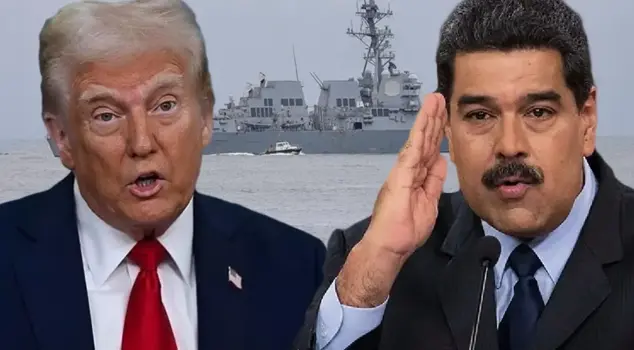
US President Donald Trump confirmed on Sunday that he recently spoke with Venezuelan President Nicolás Maduro, amid escalating tensions between the two nations. Caracas, however, condemned what it described as preparations by the United States for a potential military intervention.
The current standoff has intensified in recent months. The United States has deployed a significant military presence in the Caribbean, designated an alleged drug cartel linked to Maduro as a terrorist organization, and warned that Venezuelan airspace is “closed.” Washington maintains the military buildup, initiated in September, is intended to combat drug trafficking. Venezuela, however, accuses the US of pursuing regime change and attempting to seize control of the country’s vast oil reserves.
“I wouldn’t say it went well or badly. It was a phone call,” Trump told reporters aboard Air Force One, providing few details about the conversation. Media reports suggest the discussion included the possibility of a meeting between the two leaders and conditions of amnesty should Maduro step down, according to The Wall Street Journal and The New York Times.
Republican Senator Markwayne Mullin, speaking on CNN’s State of the Union, said the United States had offered Maduro the option to leave Venezuela for Russia or another country. Washington has also accused Maduro, the political successor to the late Hugo Chávez, of heading the so-called “Cartel of the Suns” and placed a $50 million bounty on his capture. Maduro and his allies, along with several international observers, deny the existence of such a cartel, describing the claims as attempts to criminalize the Venezuelan government.
Experts on Venezuela note that the term “Cartel of the Suns” largely refers to systemic corruption involving senior government officials and criminal gangs, rather than an organized drug cartel under Maduro’s direct control. The US does not recognize Maduro as the legitimate winner of last year’s presidential election. While Trump has not explicitly threatened military action, he recently indicated that operations to curb Venezuelan drug trafficking “by land” would begin “very soon.”
In response to mounting pressure, Venezuela has sought support from the Organization of the Petroleum Exporting Countries (OPEC). A letter from Maduro, read by Vice President and Oil Minister Delcy Rodríguez during a virtual meeting of OPEC ministers, called on member states to intervene against what Venezuela calls “American aggression.” Maduro claimed that the US is attempting to seize Venezuela’s oil reserves — the largest in the world — using military force.
The tense diplomatic environment comes as both sides engage in a high-stakes struggle over Venezuela’s political future, oil wealth, and regional influence. Observers warn that miscalculations could further escalate tensions in the Caribbean and beyond.



Leave a comment