

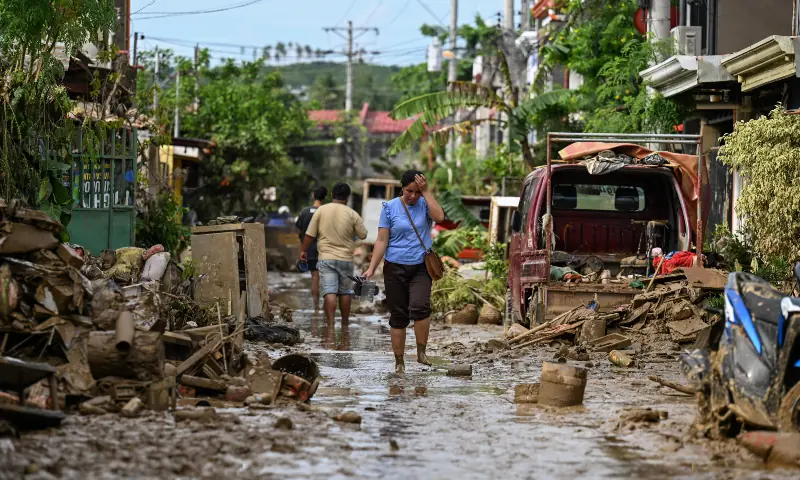
The death toll from Typhoon Kalmaegi in the central Philippines rose to more than 100 on Wednesday as authorities began assessing the full scale of devastation across Cebu province following the region’s worst flooding in decades. Entire towns were inundated by what officials described as unprecedented floodwaters that swept away vehicles, riverside homes and even large shipping containers, leaving communities reeling from destruction.
Cebu provincial spokesperson Rhon Ramos confirmed that 35 bodies were recovered in Liloan, a town within the Cebu City metropolitan area, bringing the province’s total fatalities to 76. Rescue operations were continuing in multiple flood-hit zones as emergency teams struggled to reach isolated neighbourhoods.
On neighbouring Negros Island, at least 12 people were killed and 12 others remained missing after heavy rains triggered volcanic mudflows that buried homes in Canlaon City, police Lieutenant Stephen Polinar said. He explained that deposits from recent eruptions of Kanlaon volcano had accumulated on its slopes, later collapsing onto villages under Kalmaegi’s intense rainfall. Only one of these deaths had been included in earlier official tallies, which also recorded six military personnel killed in a helicopter crash during a relief mission.
Residents described terrifying scenes as rivers burst their banks. Reynaldo Vergara, 53, said floodwaters engulfed his shop in Mandanaue before dawn. “Around four or five in the morning, the water was so strong that you couldn’t even step outside,” he said. “Nothing like this has ever happened. The water was raging.” In nearby Talisay, an entire informal settlement along a riverbank was washed away, leaving survivors to rebuild from rubble with limited resources.
Weather officials reported that Cebu City and surrounding areas were hit with 183 millimetres of rain in the 24 hours before Kalmaegi made landfall—far exceeding the region’s average monthly rainfall of 131 millimetres. Governor Pamela Baricuatro described the flooding as “unprecedented” and “devastating,” underscoring scientific warnings that climate change is fueling stronger storms by warming the oceans and intensifying rainfall. Nearly 800,000 people were evacuated ahead of the typhoon.
The disaster has also reignited public anger over a major corruption scandal involving billions of pesos allegedly allocated to “ghost” flood-control projects. Governor Baricuatro questioned whether the missing infrastructure contributed to the severity of the flash floods, telling ABS-CBN that her inspection teams had not found any structures meeting government standards, despite a ₱26.6 billion budget for such projects. A spokesperson for the Department of Public Works and Highways said the agency’s head, Vince Dizon, was in Cebu to oversee damage assessments before responding to the allegations.














Leave a comment