

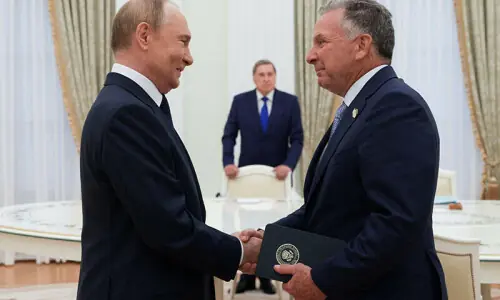
GENEVA: Ukrainian and Russian negotiators were scheduled to resume a second round of peace talks in Geneva on Wednesday, as the United States signaled cautious optimism about progress toward ending Europe’s deadliest conflict since World War II. The renewed diplomatic push comes amid continued fighting that has devastated large parts of Ukraine and claimed hundreds of thousands of lives since the war began nearly four years ago.
The latest negotiations follow two earlier rounds held in Abu Dhabi, which failed to produce a breakthrough between Moscow and Kyiv, particularly on the central dispute over territorial control. The United States has been pressing both sides to reach a settlement, but deep divisions remain over land occupied by Russian forces.
US envoy Steve Witkoff, representing the administration of President Donald Trump, expressed optimism ahead of the Geneva meeting. Writing on X, he said Trump’s diplomatic engagement had resulted in “meaningful progress” by bringing both parties to the negotiating table. Witkoff added that both delegations agreed to brief their respective leaders and continue working toward a possible agreement. A source close to the Russian delegation told AFP that the latest session lasted six hours and described the discussions as “very tense.”
Ukrainian President Volodymyr Zelensky said in his evening address that Kyiv was prepared “to move quickly towards a worthy agreement to end the war,” but questioned Moscow’s commitment to genuine peace efforts. He accused Russia of prioritizing missile strikes over meaningful diplomacy, asking rhetorically what Moscow truly sought from the negotiations.
Russia launched its full-scale invasion of Ukraine in February 2022, triggering widespread destruction across eastern and southern regions. Entire cities have been reduced to rubble, millions have been displaced, and the humanitarian toll continues to mount.
For the Geneva talks, the Kremlin reinstated nationalist figure Vladimir Medinsky, a former culture minister, as its lead negotiator. On the Ukrainian side, national security secretary Rustem Umerov headed Kyiv’s delegation and confirmed that negotiations would continue on Wednesday. Umerov thanked Washington for its mediation efforts and said he had briefed European allies on the outcomes of the first round, which he described as focusing on practical issues and possible frameworks for resolving the conflict.
He also held separate consultations with representatives from the United States and European partners — France, Great Britain, Germany, Italy, and Switzerland — to coordinate positions and discuss next steps. According to Umerov, the parties aligned their approaches on how to proceed with future discussions.
Despite the diplomatic activity, expectations for a breakthrough remain low. Kremlin spokesman Dmitry Peskov cautioned journalists against anticipating significant developments from the initial day of talks. Zelensky has repeatedly argued that Ukraine is being asked to make disproportionate concessions compared to Russia. Earlier this week, Trump publicly urged Ukraine to accelerate negotiations, warning that Kyiv “better come to the table, fast.” In an interview with Axios, Zelensky responded that it was “not fair” to pressure Ukraine alone, stressing that lasting peace could not be achieved by simply granting Russia what he described as a “victory.”
The negotiations have unfolded against a backdrop of intensified military activity. Even before the talks began, Ukraine accused Russia of undermining peace efforts by launching 29 missiles and 396 drones in overnight attacks that killed four people and disrupted electricity supplies to tens of thousands in southern Ukraine. Later, Ukraine’s general staff reported that Russia had fired 28 additional missiles and 109 guided aerial bombs during the day.
Ukrainian Foreign Minister Andriy Sybiga criticized Moscow for conducting large-scale strikes immediately before the Geneva talks, calling it evidence that Russia was disregarding peace efforts. Russia, in turn, accused Ukraine of launching more than 150 drones overnight, primarily targeting southern Russian regions and the Crimean Peninsula, which Moscow annexed in 2014.
Currently, Russia controls roughly one-fifth of Ukrainian territory, including Crimea and areas seized by Moscow-backed separatists prior to the 2022 invasion. The Kremlin is seeking full control of the eastern Donetsk region as part of any settlement and has warned it could attempt to secure it militarily if negotiations collapse. Kyiv has firmly rejected this demand, arguing that surrendering additional territory would be politically untenable and militarily risky. Ukrainian officials have also insisted that any agreement must include robust security guarantees to prevent future Russian aggression.
While Russian forces have made gradual territorial gains along parts of the front line in recent months, Moscow is also facing mounting economic challenges. Wartime pressures have slowed economic growth, the budget deficit has expanded, and oil revenues — hit by international sanctions — have fallen to their lowest levels in five years, adding further uncertainty to the conflict’s trajectory as diplomatic efforts continue in Geneva.





Leave a comment