

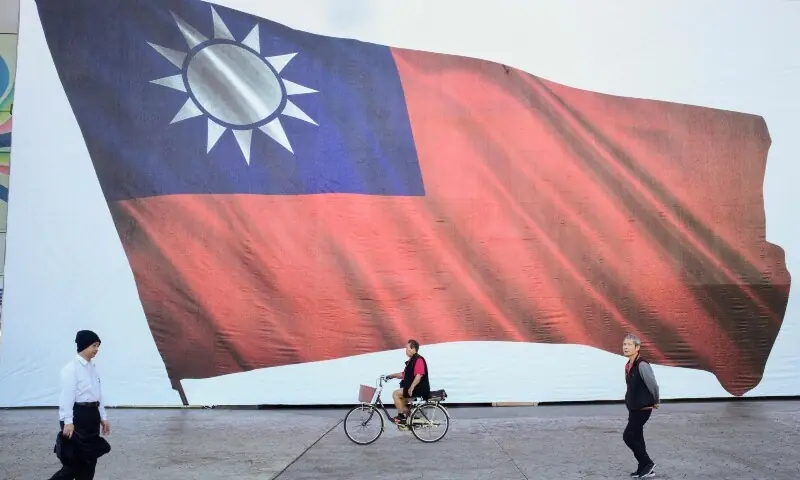
The United States has approved an arms sale worth $11.1 billion to Taiwan, marking the largest-ever US weapons package for the self-ruled island, which has been facing growing military pressure from China. The approval was granted on Wednesday and represents the second arms sale to Taiwan under President Donald Trump’s current administration.
The decision comes at a time when Beijing has intensified both military manoeuvres and diplomatic efforts aimed at asserting its sovereignty claims over Taiwan—claims that Taipei firmly rejects. Washington, while maintaining formal diplomatic relations with China, continues to strengthen its unofficial ties with Taiwan, particularly in the defence sector.
According to Taiwan’s defence ministry, the proposed arms package includes eight major defence items, such as HIMARS rocket systems, howitzers, Javelin anti-tank missiles, Altius loitering munition drones, and spare parts for existing military equipment. The ministry said the sale aligns with Taiwan’s strategy to enhance its defensive readiness and deter potential aggression.
In a statement, Taiwan’s defence ministry said the United States remains committed to helping Taiwan maintain adequate self-defence capabilities, accelerate the development of deterrence power, and expand its use of asymmetric warfare tactics. These measures, it said, are essential for preserving peace and stability in the region.
The arms package has now entered the Congressional notification stage, during which the US Congress can review, block, or amend the proposed sale. However, officials noted that Taiwan enjoys strong bipartisan support in Congress, making significant opposition unlikely.
The Pentagon, in separate announcements detailing the sale, said the weapons transfer serves US national, economic, and security interests. It added that the package would support Taiwan’s ongoing efforts to modernise its armed forces and maintain a credible defensive posture against regional threats.
Encouraged by Washington, Taiwan has increasingly focused on restructuring its military to emphasise asymmetric warfare, relying on smaller, mobile, and cost-effective systems such as drones and precision-guided weapons to counter larger forces.
Taiwan’s presidential office spokesperson, Karen Kuo, welcomed the approval, saying the island would continue to advance defence reforms, strengthen nationwide resilience, and demonstrate its resolve to defend itself. She thanked the United States for its continued support, describing peace as something that must be safeguarded through strength.
Last month, President Lai Ching-te announced a $40 billion supplementary defence budget covering the period from 2026 to 2033, stating that national security was non-negotiable amid rising regional tensions.
China’s foreign ministry did not immediately comment on the arms sale. However, Beijing has consistently opposed US arms transfers to Taiwan, viewing them as interference in China’s internal affairs.
Rupert Hammond-Chambers, president of the US-Taiwan Business Council, said systems such as HIMARS—widely used by Ukraine against Russian forces—could be crucial in countering a potential invasion. He described the package as a record level of US security assistance to Taiwan and a response to both Chinese threats and US calls for allies to take greater responsibility for their own defence.
The announcement followed an unpublicised visit by Taiwan’s Foreign Minister Lin Chia-lung to the Washington area last week, where he reportedly met US officials. Sources speaking to Reuters said the agenda of the meetings was unclear, and Taiwan’s foreign ministry declined to comment.
Although the US does not maintain formal diplomatic relations with Taiwan, it is legally obligated to help the island defend itself. Arms sales to Taipei have long been a source of friction between Washington and Beijing.
Concerns had recently emerged in the region over whether Trump’s deal-oriented approach and his planned meeting with Chinese President Xi Jinping next year might weaken US support for Taiwan. However, US officials have indicated plans to increase arms sales to Taiwan beyond levels seen during Trump’s first term.
The Trump administration’s newly released national security strategy reaffirmed Washington’s intention to deter conflict over Taiwan by maintaining military superiority in the region. The document also highlighted Taiwan’s strategic location, describing it as a key divide between Northeast and Southeast Asia.
China continues to regard Taiwan as its territory, a claim firmly rejected by Taiwan’s government, which insists the island’s future can only be decided by its people.




Leave a comment