

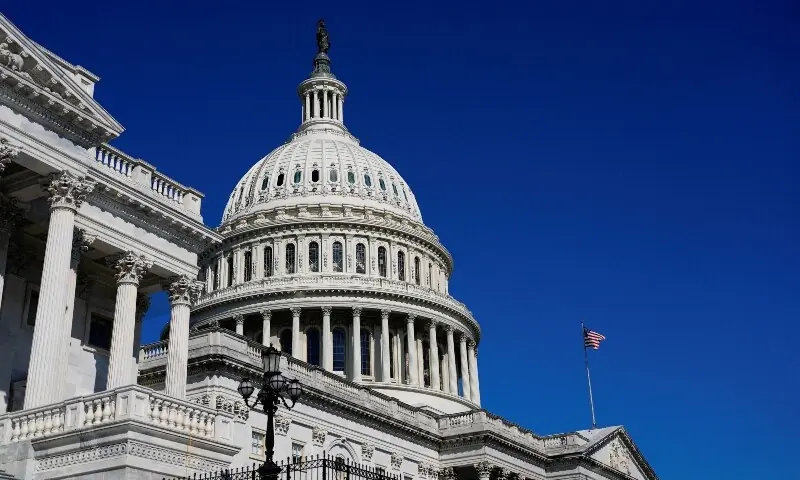
The US Senate on Sunday took a significant step toward ending the 40-day federal shutdown, advancing a measure designed to reopen government operations that have disrupted federal agencies, delayed food assistance and strained the country’s air travel system.
In a procedural vote, senators cleared a House-approved spending bill for further action. The legislation will now be amended to fund the government through January 30 and attach three full-year appropriations bills. Final approval, however, will require another vote by the Senate, followed by a fresh vote in the House of Representatives, before the measure can be sent to President Donald Trump for signature. That process could span several days.
The breakthrough came after Republicans reached an agreement with a small group of Democrats who broke with their leadership. In exchange for allowing the funding bill to move forward, Republicans committed to scheduling a December vote on extending Affordable Care Act premium subsidies, which are vital for lower-income Americans and set to expire at year’s end. Preserving these subsidies has been a major Democratic demand during the budget standoff.
The procedural vote passed 60 to 40, the bare minimum needed to defeat a filibuster. “It looks like we’re getting very close to the shutdown ending,” Trump said at the White House before the vote.
Under the bill, federal agencies would be prohibited from firing employees until January 30, halting Trump’s broader push to shrink the federal workforce. Roughly 2.2 million civilians were employed by the federal government at the start of Trump’s second term, though an estimated 300,000 are expected to exit by the end of the year due to his downsizing campaign. The legislation would also ensure back pay for all federal personnel, including members of the armed forces, Border Patrol, and air-traffic controllers.
When senators return on Monday, Republican leaders are expected to seek bipartisan consent to speed up the legislative timetable. Without such agreement, the chamber could be forced to spend most of the week working through procedural hurdles, potentially extending the shutdown into the next weekend. “It was a good vote tonight,” said Senate Majority Leader John Thune. “Hopefully, we’ll get an opportunity tomorrow to set up the next votes.”
The deal emerged after behind-the-scenes negotiations led by Democratic Senators Maggie Hassan and Jeanne Shaheen of New Hampshire, along with independent Senator Angus King of Maine, according to a person familiar with the talks. Shaheen later said that reopening the government and protecting ACA subsidies had been her core priorities.
Despite this, some Democrats expressed frustration with the agreement. Senate Minority Leader Chuck Schumer voted against the measure, while Representative Ro Khanna sharply criticized his leadership in a post on X, saying Democrats needed someone willing to fight harder for healthcare affordability.
The ongoing shutdown, now in its sixth week, continues to affect millions of Americans. Key federal services remain disrupted, including food assistance programs and national parks, while staffing shortages in air traffic control have raised concerns about worsening travel delays as the Thanksgiving travel rush approaches.
Senator Thom Tillis, a Republican from North Carolina, said the compounding strain of the shutdown nudged lawmakers toward compromise. White House economic adviser Kevin Hassett warned that if the government remains closed much longer, fourth-quarter economic growth could dip into negative territory, especially if air travel fails to stabilize before the holiday season.
Meanwhile, Trump renewed pressure to eliminate ACA marketplace subsidies and replace them with direct payments to individuals. He argued on Truth Social that the existing subsidies benefit insurance companies rather than consumers. Still, he signaled willingness to negotiate once the government is reopened.
The stakes are high for Americans shopping for 2026 ACA plans, as experts predict monthly premiums could more than double if the enhanced subsidies expire at the end of the year. The open enrollment period runs through January 15, giving lawmakers a narrow window to pass an extension if they choose to act.











Leave a comment