

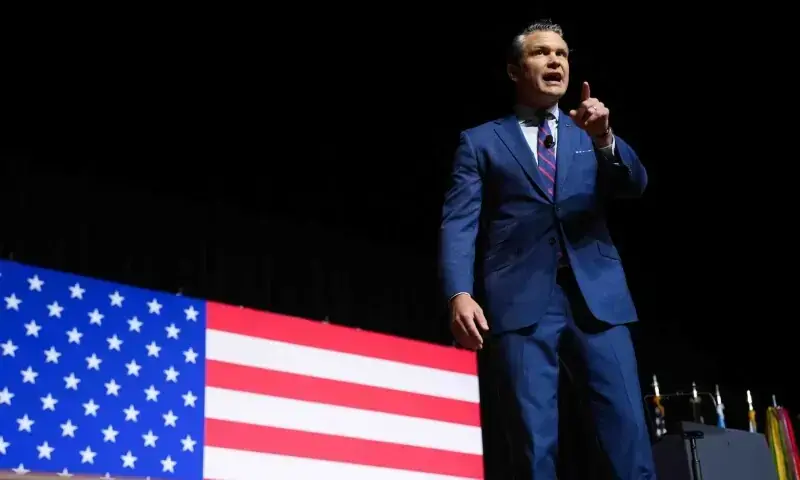
The U.S. Defence Secretary Pete Hegseth announced a new military initiative in Latin America, named Operation SOUTHERN SPEAR, declaring that its aim is to “defend our homeland, remove narco-terrorists from our hemisphere, and secure our homeland from the drugs that are killing our people.” His announcement, made on X, framed the mission primarily as a defensive step to counter drug-trafficking networks and organised criminal groups that Washington describes as a direct threat to American lives.
Despite the strong language, the U.S. provided almost no details about how this new operation will actually function. When pressed for clarification, the Pentagon offered no additional explanation, instead pointing reporters back to Hegseth’s brief social-media post. This silence has created uncertainty about the scale, scope, and rules of engagement guiding the operation, and whether it represents a shift in U.S. strategy or simply a rebranding of ongoing activities.
The announcement comes at a time when the U.S. military is already conducting significant operations in the Caribbean and eastern Pacific as part of what it calls an anti-drug campaign. Since early September, about 20 vessels have reportedly been targeted in international waters, resulting in the deaths of at least 76 people. In this context, Operation SOUTHERN SPEAR appears less like a new initiative and more like an expansion of missions the U.S. has already been carrying out for months.
The regional political backdrop is also tense. Venezuela has strongly condemned the growing U.S. naval presence near its shores, claiming that the buildup—which reportedly includes a carrier strike group and F-35 aircraft in neighbouring territories—signals preparation for possible regime-change operations. In response, the Venezuelan government has ordered a nationwide military deployment, framing the U.S. movements as a direct threat to its sovereignty. This confrontation suggests that the U.S. announcement may have as much geopolitical signalling behind it as operational planning.
Strategically, the shift in the U.S. government’s language is notable. By labelling drug-trafficking networks as “narco-terrorists,” Washington appears to be moving from a traditional counter-narcotics framework toward a counter-terrorism justification, which could open the door to more aggressive military options. Reports have already indicated that U.S. officials presented proposals for operations inside Venezuela, including potential land strikes, though no such measures have been officially authorised.
The announcement also raises critical questions about transparency, regional cooperation, and possible escalation. Latin American governments have long expressed concerns about U.S. military intervention in the region, and the lack of clarity around this new operation may heighten distrust. It remains unclear how the U.S. plans to address sovereignty concerns, prevent civilian casualties, or distinguish between legitimate security targets and political opponents of Washington’s allied governments. The absence of detailed information makes these issues even more pressing for neighbouring countries watching events unfold.




Leave a comment