

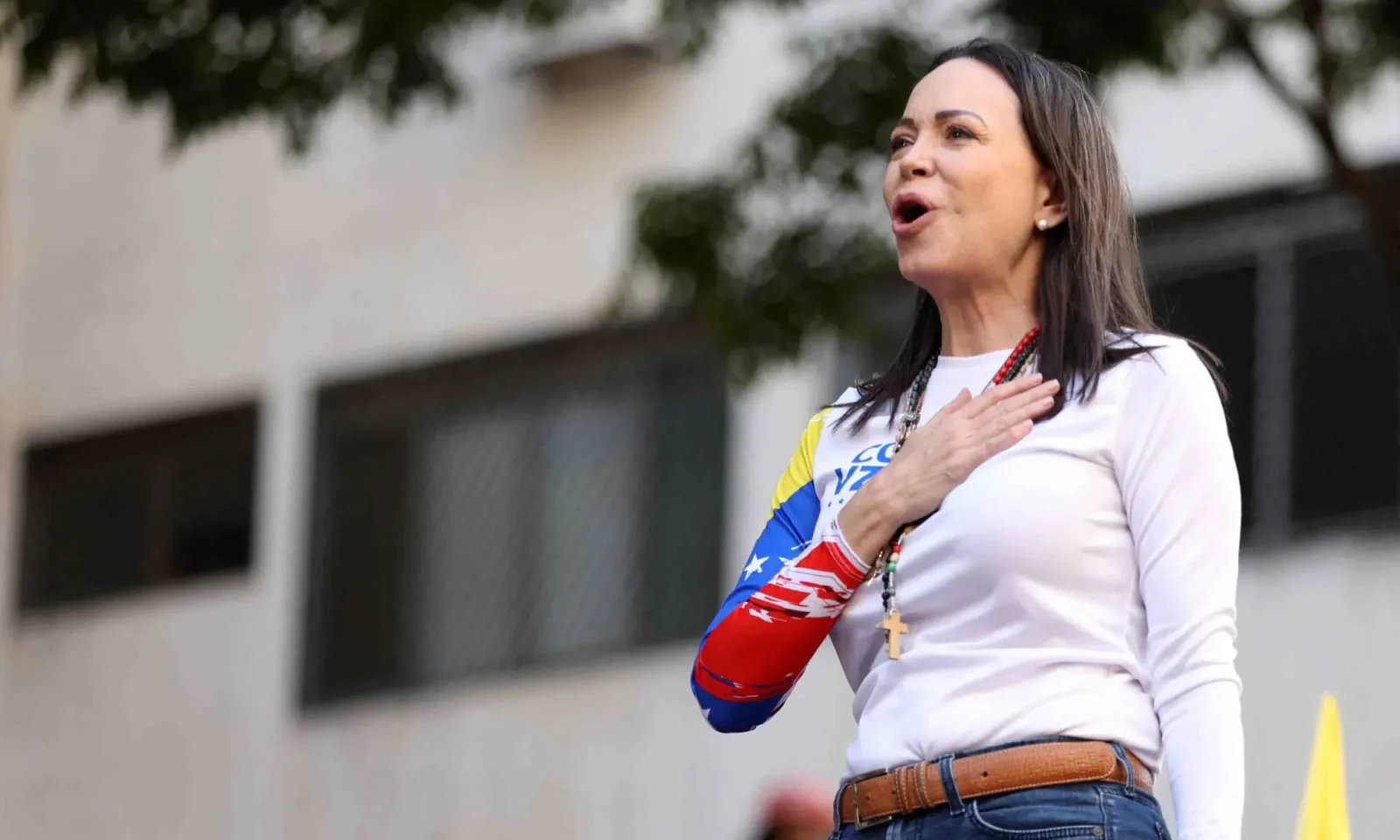
Venezuelan opposition leader Maria Corina Machado has been awarded the 2025 Nobel Peace Prize, a recognition that highlights her long struggle for democracy, human rights, and peaceful political transition in her country.
The announcement was made on Friday by Jorgen Watne Frydnes, chair of the Norwegian Nobel Committee, during a ceremony in Oslo, Norway. The decision to honor Machado, a central figure in Venezuela’s pro-democracy movement, comes at a time when the South American nation continues to grapple with economic collapse, mass emigration, and political repression under President Nicolás Maduro’s rule.
Recognition of Democratic Struggle
In announcing the award, Frydnes praised Machado for her “tireless work promoting democratic rights for the people of Venezuela and for her struggle to achieve a just and peaceful transition from dictatorship to democracy.” He described her as “one of the most extraordinary examples of civilian courage in Latin America in recent times,” commending her leadership in uniting Venezuela’s fractured opposition.
“As the leader of the democratic forces in Venezuela, she has been a key unifying figure in an opposition that was once deeply divided,” Frydnes said. “That opposition has found common ground in the demand for free elections and representative government.”
A Message About Democracy
The committee’s statement also carried a broader message about the fragility of democracy worldwide. “This is precisely what lies at the heart of democracy: our shared willingness to defend the principles of popular rule even though we disagree,” Frydnes said. “At a time when democracy is under threat, it is more important than ever to defend this common ground.”
The Nobel Committee’s decision to focus on Venezuela this year also comes against the backdrop of renewed global debates about authoritarianism and freedom — and notably during a year in which US President Donald Trump has repeatedly claimed he deserves the Nobel Peace Prize himself.
Venezuela’s Political Crisis
In explaining its choice, the committee drew attention to the deteriorating political and humanitarian situation in Venezuela, once one of Latin America’s wealthiest nations. “Venezuela has evolved from a relatively democratic and prosperous country to a brutal and authoritarian state suffering from a deep humanitarian and economic crisis,” Frydnes said.
He noted that “most Venezuelans live in deep poverty even as the few at the top enrich themselves,” adding that “the violent machinery of the state is directed against its own population.” Nearly eight million Venezuelans have fled the country in recent years, according to UN estimates, in one of the world’s largest migration crises.
The committee also condemned the government’s systematic suppression of dissent, citing election rigging, political persecution, and imprisonment of opposition leaders as tools of state control.
Symbol of Peaceful Resistance
Maria Corina Machado, 57, has long been a leading voice of Venezuela’s democratic resistance. A former lawmaker and presidential candidate, she has faced numerous arrests, bans, and intimidation attempts by the Maduro regime. Despite these pressures, she has continued to call for nonviolent civic mobilization and international support for democratic restoration.
Her Nobel recognition places her among other iconic global figures who have received the Peace Prize for defending democracy and human rights — including Aung San Suu Kyi, Lech Wałęsa, and Nelson Mandela.
This year’s award also reflects the Nobel Committee’s broader concern over the rise of authoritarianism and the decline of democratic values worldwide. Machado’s Nobel Peace Prize includes a gold medal, a diploma, and a $1.2 million (USD) cash award, which will be presented at a ceremony in Oslo on December 10, the anniversary of Alfred Nobel’s death.








Leave a comment