

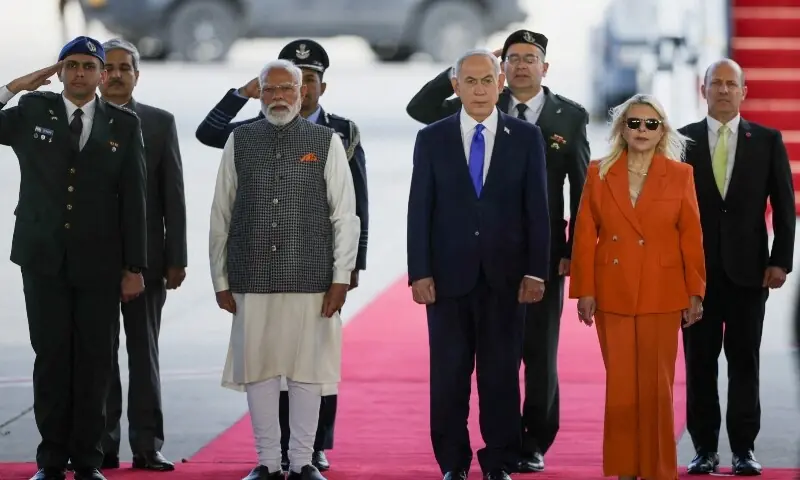
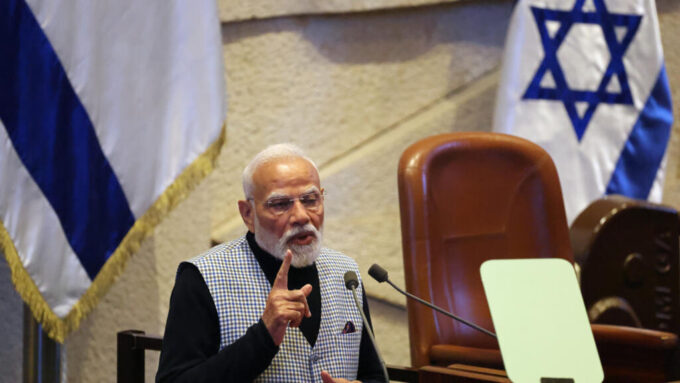
JERUSALEM: Prime Minister Narendra Modi told Israeli lawmakers on Wednesday that India stands “firmly” with Israel following Hamas’s attack on October 7, 2023. Speaking in the Knesset, Modi expressed deep condolences for the lives lost in the terrorist attack, stating, “We feel your pain, we share your grief. India stands with Israel firmly with full conviction in this moment and beyond.”
During his two-day visit, Modi also met with Israeli Prime Minister Benjamin Netanyahu to discuss deepening trade and defence ties, with a particular focus on innovation, cybersecurity, and strategic cooperation.
“I see a lot of synergies in areas such as quantum technologies, semiconductors and artificial intelligence,” Modi said, highlighting economic and technological cooperation as the “natural foundation for our forward-looking partnership.”
Modi and Netanyahu Highlight ‘Real Friendship’
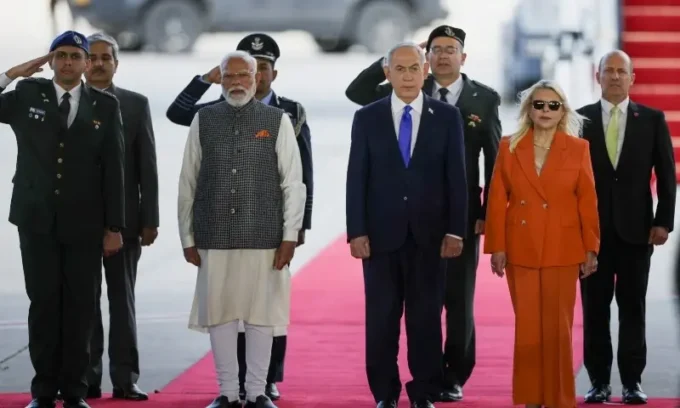
Modi was greeted at Ben Gurion Airport with a red carpet ceremony and a personal hug from Netanyahu, underscoring the leaders’ close ties. Netanyahu’s office described the bilateral relationship as a powerful alliance in innovation, security, and shared strategic vision.
The leaders held private discussions about regional developments, India-Israel economic cooperation, and ongoing negotiations for an India-Israel Free Trade Agreement (FTA), noting that bilateral merchandise trade reached $3.62 billion in 2024-2025. Modi is also scheduled to meet Israeli President Isaac Herzog during the visit.
India-Israel Strategic and Economic Partnership
Despite domestic criticism, Modi emphasized India’s long-term strategic and economic partnership with Israel, citing defence, agriculture, technology, and cybersecurity cooperation. The India-Middle East-Europe Economic Corridor plan, linking ports, railways, electricity, data networks, and pipelines, remains a key part of India’s regional strategy.
Modi’s current visit marks his second as prime minister, following his 2017 visit to Israel, and reflects New Delhi’s strengthened bilateral ties under his leadership, even as geopolitical tensions in the Middle East remain highly sensitive.
Axis of Evil
The Indian leader did not mention the loss of Palestinian life in the war during his Knesset address. A UN special committee and a commission of inquiry as well as outside academic experts have labeled Israel’s actions in Gaza a “genocide.” Israel denies this characterization. India’s opposition parties have mounted fierce criticism of Prime Minister Narendra Modi over his visit to Israel, calling the trip a betrayal of India’s historic foreign policy principles and a display of “moral cowardice” at a moment of intense global scrutiny of Israeli policies. Senior Congress leaders, including Priyanka Gandhi, questioned why Modi did not address the devastation in Gaza, including destroyed neighborhoods, bombed hospitals, and families uprooted from their homes.
Congress parliamentarian Jairam Ramesh condemned Modi’s visit, saying he was displaying “moral cowardice” by publicly embracing Netanyahu while Palestinians endure massive civilian casualties and displacement.
Critics have compared Modi’s stance to historical instances of selective diplomacy, emphasizing that supporting one side while ignoring widespread human suffering diminishes moral authority. A widely circulated statement said:
“Butcher of Gujrat, speaking to Butchers of Gaza. Why are you silent about more than 70,000 shattered families in Gaza? Entire neighborhoods reduced to rubble. Children pulled from debris. Parents burying their sons and daughters. Hospitals bombed. Refugee camps struck. Generations erased in seconds. Is their grief less human? Is their blood less red?”
The statement highlighted widespread displacement, hunger, disease, and winter hardships facing Palestinians, criticizing the moral imbalance of mourning one tragedy while ignoring another.






Leave a comment