

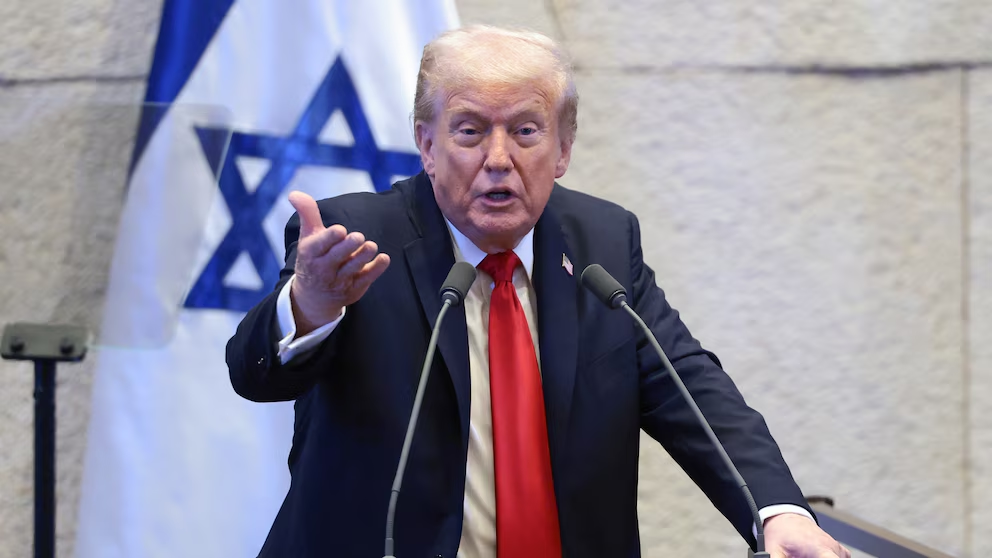
When U.S. President Donald Trump stepped into Israel’s Knesset to deliver what he called a “speech for peace,” it was less a statesman’s address and more a theatrical showcase of exaggeration, distortion, and self-congratulation. Behind the applause and rhetoric lay a speech crafted to glorify his image rather than to promote genuine diplomacy.
Trump’s remarks were riddled with claims that ranged from misleading to outright false. He boasted that U.S. strikes had “obliterated” Iran’s nuclear infrastructure and declared that Tehran was “two months away from building a bomb.” However, independent assessments from Western intelligence agencies and international nuclear watchdogs have consistently stated that Iran’s nuclear program remains largely intact and that it is not actively developing a nuclear weapon.
The president also portrayed the recent Gaza ceasefire and hostage exchanges as proof of his unparalleled negotiating genius, describing it as “the greatest peace deal ever made.” Yet, the ground reality in Gaza remains dire. While Hamas released the last surviving Israeli hostages, dozens of bodies remain in captivity, and key political and humanitarian issues remain unresolved. The ceasefire brought temporary calm, not peace — and certainly not the sweeping transformation Trump so triumphantly proclaimed.
Trump lavished praise on Israel’s military campaign, insisting that “Israel’s victory is a victory for peace.” But this framing ignored the immense devastation in Gaza, where tens of thousands of civilians have been killed, neighborhoods flattened, and a humanitarian crisis deepened. By turning a blind eye to these realities, Trump transformed a tragedy into a political trophy, erasing the suffering of Palestinians from his narrative altogether.
Equally troubling was his assertion that the “Middle East has never been closer to harmony.” The region, however, remains mired in unresolved conflicts — from Lebanon and Yemen to Syria and Iran — all of which have been inflamed, not pacified, by the Gaza war and its regional spillovers. Trump’s rhetoric about regional peace amounts to little more than wishful thinking dressed up as achievement.
His speech was also characterized by rampant self-promotion. He claimed credit for “ending eight wars in eight months,” though in reality, most of those so-called resolutions were fragile ceasefires that could collapse at any moment. His declaration of “a golden age for Israel and the United States” overlooked the deep divisions at home and the growing criticism of U.S. foreign policy abroad.
Trump’s portrayal of Iran as a humbled adversary “begging for peace” reflected the same bravado that defined much of his foreign policy. In reality, Iranian leaders have rejected U.S. terms for negotiation and continue to resist what they view as coercive diplomacy. Far from being cornered, Tehran remains a key regional player capable of influencing conflicts from Iraq to Lebanon.
Perhaps the most telling moment of Trump’s Knesset appearance came when Israeli lawmaker Ofer Cassif protested during the speech and was forcibly removed from the chamber. His silent act of defiance symbolized what many observers felt — that this was less a diplomatic address and more a spectacle built on propaganda and selective truth.
Trump’s appearance in the Knesset was meant to cement his legacy as the architect of a new Middle East order. But the performance, heavy on ego and light on substance, revealed a far different reality: a leader desperate to rewrite history, mask contradictions, and convert chaos into political glory. Behind the applause and pageantry lay a hollow narrative — one that sought to obscure the enduring pain, destruction, and divisions that still define the region.
In the end, Trump’s Knesset speech will be remembered not for its diplomacy or sincerity but for its audacity — a masterclass in political theatre, where fiction wore the costume of fact and applause drowned out accountability.








Leave a comment