

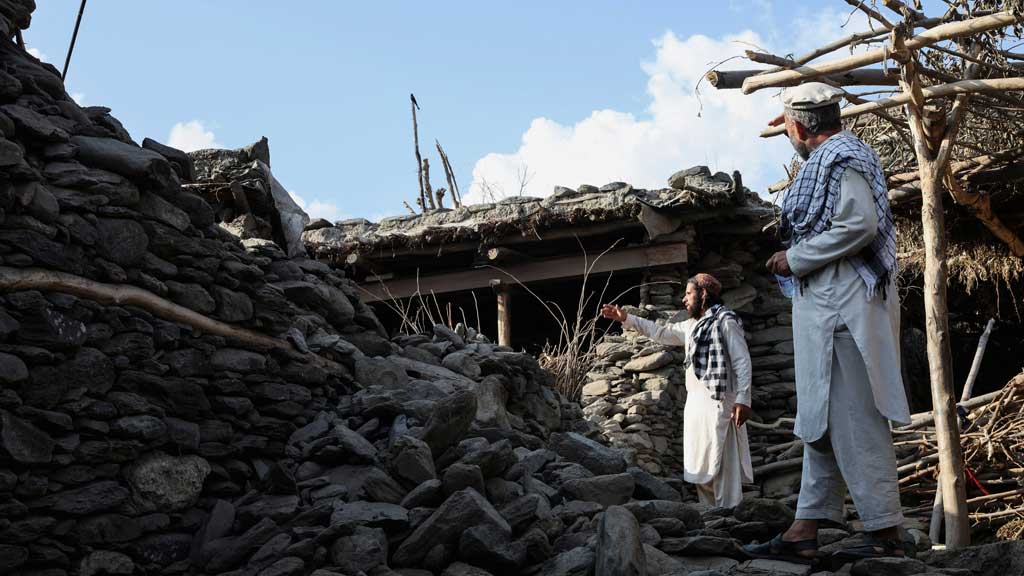
Haunted by the risk of fresh aftershocks and landslides, survivors of the recent earthquakes in Afghanistan are refusing to return to their devastated mountain villages. Families have instead taken shelter in open fields and along riverbanks, despite lacking proper tents or protection from the elements.
In Masud village of eastern Kunar province, 67-year-old farmer Adam Khan stood before his collapsed home, describing the fear that grips residents. “It rained last night, we had no place to take cover,” he said. “Our biggest fear is the big rocks that could come down at any moment.”
Since August 31, two powerful earthquakes have killed more than 2,200 people and injured over 3,600 across the region, destroying thousands of mud-and-stone houses. The tremors also destabilized surrounding hillsides, triggering landslides that threaten to bury already vulnerable communities caught between crumbling mountains and rising rivers.
Relief operations have been hindered by Afghanistan’s rugged terrain. Helicopters have dropped food and basic supplies, but survivors say aid has been inconsistent, with many remote villages still cut off by damaged roads. Families now cluster in improvised camps, relying on salvaged belongings to survive.
“The tents they gave us cannot even accommodate our children,” said farmer Shams-ur-Rahman, who lost six relatives and walked down the mountain barefoot with his son. Another survivor, 51-year-old Gul Ahmad, said fear of further landslides makes returning impossible. “Even if there is no earthquake, a simple rainfall could bring rocks crashing down. We will not go back. The government must provide us a safe place.”
Humanitarian groups warn that the crisis underscores Afghanistan’s vulnerability to environmental disasters, where fragile infrastructure, poverty, and unstable geology combine to magnify risks. Without proper shelter, sanitation, and food security, experts caution that outbreaks of disease and deepening poverty are likely.
Children remain among the most traumatized. Twelve-year-old Sadiq, who was trapped under rubble for 11 hours, recalled: “I thought I would die. It felt like doomsday.”
At the United Nations, Shannon O’Hara, Head of Strategy and Coordination for OCHA Afghanistan, is expected to brief on the humanitarian and environmental response to the quakes, highlighting the urgent need for both immediate relief and long-term resilience planning.












Leave a comment