

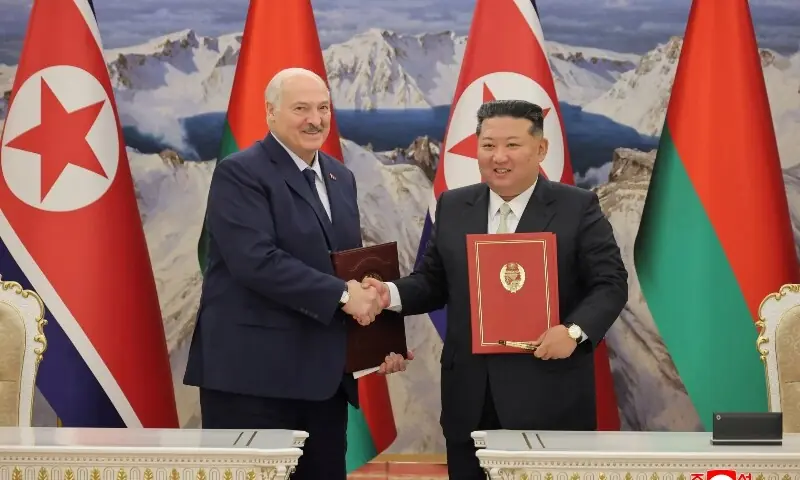
PYONGYANG: North Korea and Belarus have formalized their alliance by signing a “Friendship and Cooperation” treaty during the first-ever visit of Belarusian President Alexander Lukashenko to North Korea. The signing followed a lavish reception from North Korean leader Kim Jong Un, featuring artillery salutes, goose-stepping troops, and a large flag-waving crowd, highlighting the two nations’ intent to publicly showcase their solidarity.
The treaty underscores growing ties between the two leaders, both of whom face Western sanctions and allegations of severe human rights violations. Lukashenko, who has ruled Belarus since 1994 and strongly backs Moscow’s war in Ukraine, laid a bouquet on behalf of Russian President Vladimir Putin during his visit to the Kumsusan Palace of the Sun, where Kim’s father and grandfather lie in state.
According to Belarusian state media Belta, Lukashenko emphasized the need for “independent countries [to] cooperate more closely and consolidate their efforts aimed at protecting their sovereignty and improving the well-being of their citizens,” while Kim expressed support for Belarus in resisting “illegitimate pressure from the West” and praised its measures to ensure stability and development.
The two sides also discussed expanding cooperation beyond military and diplomatic ties. Belarusian Foreign Minister Maxim Ryzhenkov noted potential trade growth in pharmaceuticals, food, and North Korean cosmetic products. The agreement covers broader fields including agriculture, information exchange, and economic collaboration, though current trade between the nations remains modest.
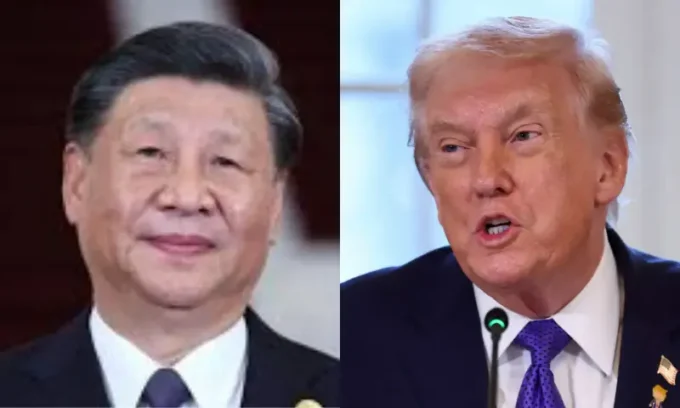
The visit reflects the broader anti-Western alignment promoted by Russian President Vladimir Putin and Chinese President Xi Jinping, aiming to establish a “multipolar world” to challenge Western hegemony. Both Belarus and North Korea have contributed to Russia’s war in Ukraine: Minsk has served as a strategic base for Russian operations, while North Korea is reported to have sent thousands of soldiers, artillery shells, missiles, and rocket systems to support Moscow, primarily in the Kursk region.
The treaty builds on existing ties between North Korea and Russia, formalized in a 2024 strategic partnership obliging both sides to provide military or other assistance if attacked. Analysts note that Pyongyang is also receiving financial aid, military technology, food, and energy from Moscow, reducing its dependence on China.
Observers say the visit is intended to strengthen North Korea’s diplomatic profile and signal solidarity among nations opposing the Western-led order. Lee Ho-ryung of the Korea Institute for Defense Analyses told AFP, “Kim will try to use the occasion to raise its diplomatic profile and strengthen solidarity among the so-called anti-Western bloc.”
The signing of the Friendship and Cooperation treaty marks a deepening of ties between two isolated nations under sanctions, aligning their political, economic, and strategic interests amid escalating global tensions.



Leave a comment