

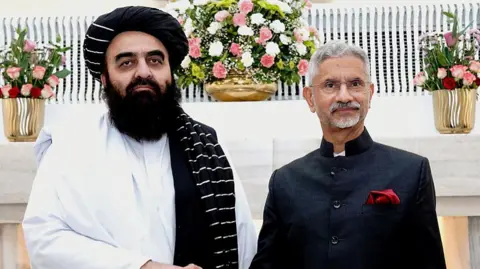
Afghan Foreign Minister Amir Khan Muttaqi on Sunday offered an explanation for the exclusion of women journalists from a press conference he held in New Delhi on Friday, after the decision fueled a wave of domestic and international criticism.
Muttaqi said, in a Pashto-language video posted by Indian news agency ANI, that the omission was not intentional discrimination but the result of logistical decisions made by his team. “Our teams had contacted a limited number of journalists for the press conference, and only those journalists were invited,” he said. “It later emerged that some journalists were not on the list… it was just this decision and no other.” Dawn
He denied that there was a deliberate exclusion or ban. “Our colleagues thought that those who had been on the list should be invited. So, the participants were limited,” he added. Dawn
Criticism and Political Fallout
The reaction in India was swift and sharp. The Congress party, now in opposition, condemned the exclusion, accusing the Modi government of tacitly allowing or endorsing discriminatory practices on Indian soil.
Former Congress leader Rahul Gandhi posted on X (formerly Twitter):
“Mr Modi, when you allow the exclusion of women journalists from a public forum, you are telling every woman in India that you are too weak to stand up for them. … Your silence in the face of such discrimination exposes the emptiness of your slogans on Nari Shakti (women’s power).”
His sister, Priyanka Gandhi Vadra, also questioned whether the Indian leadership’s embrace of women’s rights was merely rhetorical, asking how such an “insult” could occur in Delhi.
Another Congress leader, Jairam Ramesh, went further, saying it was shocking and unacceptable that the Indian government allowed the Taliban’s exclusion of female journalists to play out in New Delhi.
Left-wing and communist leaders also voiced outrage. D. Raja, secretary-general of the Communist Party of India, asked whether the exclusion represented “Taliban misogyny” or a tacit endorsement by India, referencing India’s foundational commitment to equality.
Some critics even argued that male journalists should have walked out in protest when they realized their female colleagues were left out — a gesture they said would have underscored solidarity.
Context: Afghanistan’s Gender Policies Under the Taliban
The controversy surrounding the press conference cannot be divorced from the broader context of the Taliban’s record on women’s rights. Since returning to power in 2021, the Taliban government in Kabul has imposed sweeping restrictions on women’s public and private lives — banning them from universities, parks, gyms, and beauty salons, among other measures. The United Nations and various rights groups have described many of these policies as a form of gender apartheid.
The invitation policy — whether deliberate or accidental — thus touched a sensitive nerve: the exclusion of women from a public diplomatic forum amplified concerns about the Taliban’s ongoing efforts to marginalize women from public life.







Leave a comment