

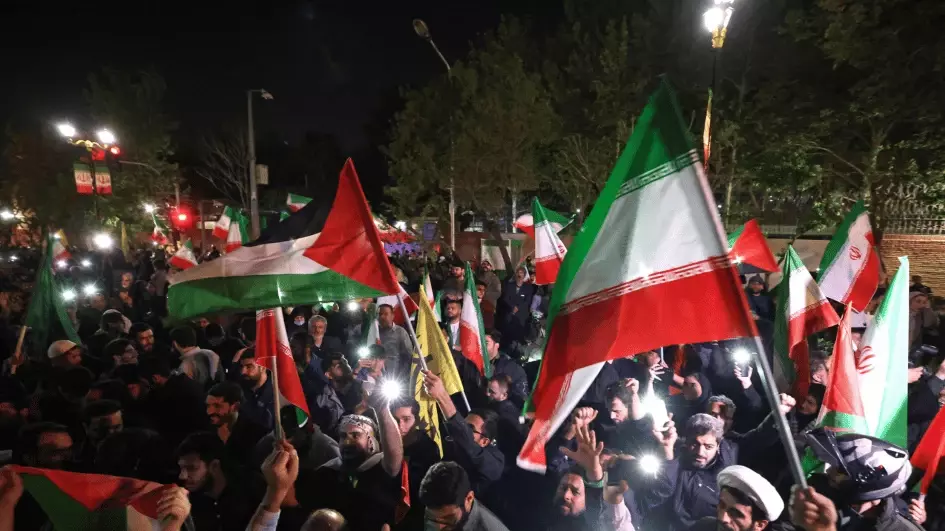
In Tehran, the streets begin to fill before the call to prayer has fully dissolved into the evening air. Families arrive first, parents walking with children, elderly men leaning on canes, and teenagers carrying folded flags under their arms.
Across Iran, in cities such as Mashhad, Isfahan, Shiraz, and Tabriz, the same pattern unfolds with striking consistency as people step into streets and public squares.
A nationwide nightly movement after weeks of conflict
More than fifty days have passed since February 28, when the United States and Israel reportedly launched coordinated military aggression against Iran, including the assassination of the Leader of the Islamic Revolution and senior officials and commanders.
Among those killed were, most notably, 168 elementary schoolchildren in Minab, a detail repeatedly referenced in nightly gatherings that followed.
The total civilian death toll during the imposed war is reported to have reached 3,375.
Life under airstrikes and nightly gatherings
During these gatherings, warplanes have reportedly been heard overhead. Residents in some areas described the sound of fighter jets and munitions passing through the night sky while crowds remained in the streets below.
Despite conditions that typically lead to dispersal in conventional warfare logic, people continued to remain outside in large numbers.
They gathered in squares and along main roads even as aircraft noise filled the air, responding with chants such as “God is great,” echoing across crowds.
This pattern—gathering, chanting, dispersing, and returning the next night—has repeated since the early days of the conflict.
Some individuals reportedly stayed out all night in rain and cold, refusing to leave streets that have effectively become another frontline of the conflict.
From mourning to sustained civic ritual
Initially, the gatherings were interpreted as mourning—black banners, Qur’anic recitations, and portraits of the martyred Leader.
However, as weeks passed, participation increased and the gatherings evolved into a repeated, structured nightly civic ritual.
Loudspeakers carried slogans and prayers, shopkeepers closed early to join, and entire neighborhoods moved outward together in larger cities.
Observers note that while external commentary often frames such movements as either spontaneous or centrally coordinated, the situation does not clearly fit either category.
No central call, but shared rhythm
Over more than seven weeks, there has been no consistent evidence of a single central directive calling people into the streets.
Instead, people appear at similar times, following familiar routes into public squares, often without visible instruction.
This repetition has created what some describe as a stabilized social pattern based on shared memory and expectation rather than formal organization.
As Nairay Lawasani told Press TV, “It is an unwritten understanding… the street, in this moment, is not merely a space but a responsibility.”
Personal testimonies from participants
Lawasani said the military aggression and civilian deaths deepened her resolve to participate:
“After the martyrdom of the Leader, I felt my heart would burst. I had to go out… These gatherings saved me.”
Another participant, Zahra Noorani, described a personal transformation:
She said the gatherings made her reflect on life’s purpose and called them “a sacred ritual” that changed her outlook.
Analysts: gatherings as “awakening,” not impulse
Political analyst Saeed Dehnavi described the movement as rooted in intellectual and religious tradition rather than emotional reaction.
He referenced the concept of “baseth,” describing it as a collective awakening of human conscience.
Dehnavi said that after the recent events, what was previously abstract had become visible:
“What we saw was exactly that… an inner call and a collective response.”
Counter-narrative in information warfare
Some analysts argue the gatherings also serve an external function.
Hamidreza Taheri, a political scientist, said there is a parallel information battle underway, with Western media allegedly portraying instability in Iran.
He said the presence of sustained crowds in public spaces acts as a counter-signal:
“One night can be dismissed. Fifty cannot.”
Leadership framing of public presence
Following the ceasefire that reportedly came into effect on April 7, public messaging emphasized continued participation.
Statements attributed to the Leader of the Islamic Revolution stressed that even during pauses in conflict, public presence remains essential.
He stated that presence in public spaces, neighborhoods, and mosques becomes even more important during such periods.
He also noted that public chants in squares influence broader outcomes beyond the streets.
Symbols, flags, and slogans in the streets
Flags are a constant presence in the gatherings, particularly the Iranian flag. In some locations, flags associated with Palestine and Hezbollah are also visible.
Portraits of martyred commanders and political figures are carried alongside banners.
Slogans frequently include denunciations of the United States and Israel, alongside affirmations of national endurance.
Observers note that visibility itself is repeatedly emphasized as a form of symbolic deterrence.
Children as part of the gatherings
Children are present throughout the nightly gatherings, often standing with parents or moving in groups.
One widely circulated moment involved a young girl who asked IRGC Aerospace commander General Seyed Majid Mousavi to “hit Tel Aviv with a pink missile.”
The military later reportedly painted a missile pink in symbolic response before its launch.
The moment became widely shared and referenced as a symbolic expression of childlike interpretation within a wartime environment.
Parents also describe children repeating slogans at home, with one father noting his son imitates chants using a broom as a microphone.
Generational continuity of public protest
Analysts note that public streets in Iran have historically played a role in political expression, from the Islamic Revolution to earlier movements such as the Tobacco Movement and the Constitutional Revolution.
What distinguishes the current moment, observers say, is the sustained, nightly repetition of gatherings over an extended period.
A repeating nightly cycle
Each evening follows a similar sequence: people arrive, groups form, chants rise, and crowds gradually disperse.
By the next night, the same pattern begins again—now embedded into the rhythm of daily life in multiple Iranian cities.









Leave a comment